BBC Radio 4
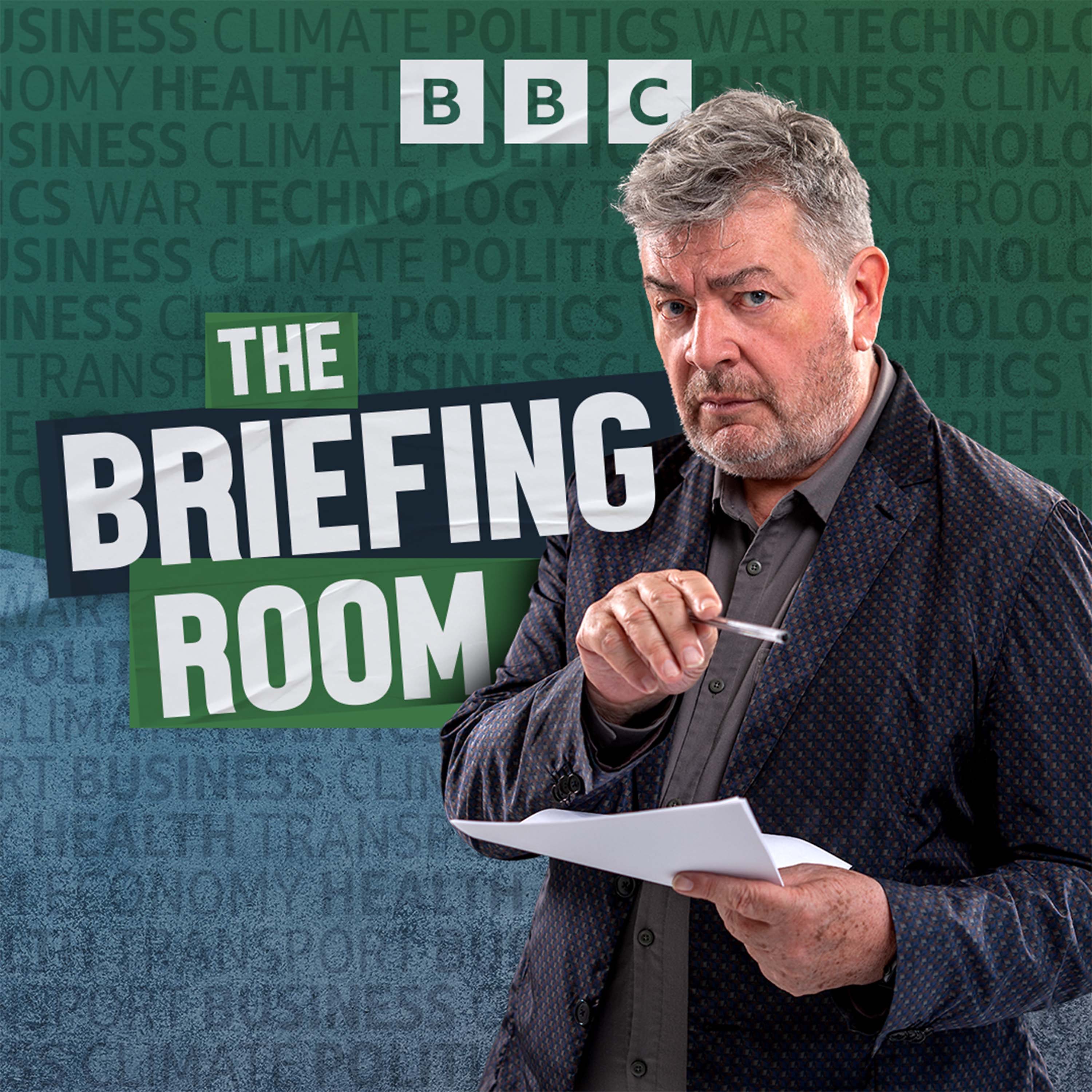
The Briefing Room
David Aaronovitch and a panel of experts and insiders present in-depth explainers on big issues in the news
Besuch unbedingt die Website des Podcasts und unterstütze die Macher: www.bbc.co.uk
Wo hören?
Podcasts in der App Replaio Radio Bald verfügbarPodcasts kommen bald in die App. Installiere sie jetzt und erlebe als Erster einen ganz neuen Blick auf Podcasts
 Kostenlos installieren
Android fast 10 Mio. Downloads · Bewertung 4,8
iOS bald
Folgen
Ukraine: Who is winning? 21.07.2022 28:53
The war in Ukraine is about to enter its sixth month. The cost of Russia’s invasion has been enormous: millions of refugees; thousands of dead soldiers; thousands more dead civilians; and billions of dollars’ worth of physical damage. It’s the most consequential military conflict for a generation. This week the Briefing Room investigates what’s happening now on the ground and whether either side i...
Covid - how worried should we be this time? 14.07.2022 29:03
More than two years after the emergence of Covid, infection levels are high once again. The Office for National Statistics estimates that 2.7 million people, or 1 in 25 of us, have got Coronavirus. There’s concern too about new Omicron variants BA.4 and BA.5 – mutations which help the virus re-infect our bodies. But how worried should we actually be this time? Are the mutations normal or an alarmi...
What's wrong with the NHS, and how do we fix it? 09.06.2022 29:01
Last year spending on health and social care in the UK hit nearly £200bn. That’s roughly a fifth of total government spending. Yet the perception has been that things have got worse. Have they? If so, how much worse? How do we compare with other similar countries? And what might we do differently? Joining David Aaronovitch in the briefing room are: Siva Anandaciva, Chief Analyst at the King’s Fund...
What's happening in Afghanistan? 02.06.2022 29:11
Last year the Taliban launched an offensive in Afghanistan that, within a matter of weeks succeeded beyond the West’s wildest nightmares. In August Kabul fell and life changed dramatically for the Afghan people. Since then they’ve faced food shortages, a failing economy and a bombing campaign launched by Afghanistan’s own ISIS, ISIS-K. So is it Taliban 2.0 as some people hoped? How is it dealing w...
Is the crypto bubble bursting? 19.05.2022 29:11
Last week cryptocurrency suffered it’s ‘black Wednesday’ moment. Investors raced to withdraw their funds and more than $200billion was wiped off the cryptocurrency market. One currency lost 98% of its value. Ironically it was a so-called “stablecoin”, whose value is meant to be pegged to currencies like the dollar, that collapsed. Was this a solitary - but very costly - blip or is the crypto bubbl...
What impact will the Northern Ireland election have? 12.05.2022 29:36
The election in Northern Ireland saw nationalists, Sinn Fein, win the most votes. Their leader, Michelle O'Neill, becomes first minister. It has been heralded as a historic result. But what will its impact - on Stormont politics, the protocol and the union - end up being? Joining David Aaronovitch in the briefing room are: Enda McClafferty, BBC Northern Ireland's political editor Ann Watt, directo...
How has the war in Ukraine changed German politics? 05.05.2022 29:10
In late February, German chancellor Olaf Scholz described Russia's invasion of Ukraine as a ‘Zeitenwende’ - turning point - sparking the biggest shift in German foreign policy since the Cold War. The highlights included a 100bn euro package to boost the military and meet Nato’s 2 per cent of GDP defence spending obligation, send weapons to Ukraine and end his country’s dependency on Russian energy...
What's the impact of the Shanghai lockdown? 28.04.2022 29:25
What will the social and economic costs be of China's full-scale lockdown of Shanghai? David Aaronovitch examines the problems with the country's vaccination programme. Joining David in the briefing room are: Robin Brant, BBC Correspondent based in Shanghai Vincent Ni, China Affairs correspondent for The Guardian Professor Nancy Qian, Northwestern University Dr Yu Jie, senior research fellow on Ch...
Will the Rwanda plan work? 21.04.2022 29:41
The Home Secretary, Priti Patel, has unveiled a plan to stop small boat crossings in the English Channel by sending asylum seekers to Rwanda. But will it work? Joining David Aaronovitch in the briefing room are: Mark Easton, BBC's Home Editor Alexander Betts, Professor of Forced Migration and International Affairs at the Refugees Studies Centre Nicolas Rollason, partner and head of Business Immigr...
Russia's invasion: what more can the west do to help Ukraine? 24.03.2022 28:55
It's a month now since Russian forces invaded Ukraine. The west have sanctioned Russia and provided aid packages to Ukraine but what more can it do to help Ukraine win the war? Joining David Aaronovitch in The Briefing Room are: Gustav Gressel, senior policy fellow with the Wider Europe Programme at the European Council on Foreign Relations (ECFR) Berlin office. Dr Sarah Schiffling, International...
Russia's invasion: what could a peace deal look like? 17.03.2022 28:44
Negotiations between Ukraine and Russia have been underway this week. At the same time Mariupol and other Ukrainian cities have come under savage bombardment. If some sort of peace is to be brokered what compromises might be possible and what will be required to get there? David Aaronovitch is joined by: Oleksiy Semeniy, former advisor to the National Security and Defense Council of Ukraine Aglaya...
Russia's invasion: what level of support does Putin have at home? 10.03.2022 29:11
What's the impact in Russia of painful sanctions and a war that's not going to plan? How is President Putin controlling information and what's required for that to change? David Aaronovitch is joined by: Michael Clarke, Visiting Professor of War Studies at Exeter University and former director, Royal United Services Institute Sergei Guriev, Professor of Economics at Sciences Po in Paris and former...
Russia's invasion: what's the military strategy? 03.03.2022 29:39
The war in Ukraine is a week old. What have we learned about the military strength - and tactics - on both sides? And what might that tell us about how the conflict might play out? David Aaronovitch is joined in The Briefing Room by: Vitaliy Shevchenko, Russian editor at BBC Monitoring. Colonel Liam Collins, founding director of the Modern War Institute in New York. Ed Arnold, Research Fellow in E...
Russia's invasion: will sanctions work? 24.02.2022 29:01
Russia is facing sanctions from around the world. Can they hit the country hard enough to make it change course and leave Ukraine in peace? In a live episode David Aaronovitch considers how sanctions have worked in other crises, why they are so frequently used and what circumstances are required for them to be successful. He is joined by: Lee Jones, Professor of International Politics at Queen Mar...
What do drones mean for the future of warfare? 17.02.2022 29:23
A few weeks ago a rebel group without an air-force managed to attack a foreign airport 1,000 miles away....from the air using drones. And theoretically what the Yemeni insurgents did in Abu Dhabi is repeatable the world over. Indeed is being repeated. Meanwhile drones are often the weapon of choice for major powers operating a long way from home. So are drones transforming the way conflicts are fo...
Will the levelling up plans work? 10.02.2022 28:23
One of Boris Johnson’s key campaign promises in the run up to the last election was to level up the country. Now the government has published a white paper telling us how it intends to do that. So what are the plans, will they work and do they go far enough? David Aaronovitch is joined by: Jagjit Chadha, Director of the National Institute of Economic and Social Research (NIESR) Jennifer Williams,...
Is the Prime Minister’s Office fit for purpose? 03.02.2022 28:34
How well 10 Downing Street functions is under scrutiny. Following Sue Gray's report into parties during lockdown, David Aaronovitch explores who does what at the heart of government and asks if the current problems can be fixed. Contributors: Alex Thomas, Institute for Government Professor Andrew, Blick, King's College London Jill Rutter, UK in a Changing Europe Professor Patrick Diamond, Queen Ma...
How do we learn to live with Covid? 27.01.2022 28:50
Plan B Covid restrictions in England have ended and the government says we must learn to live with Covid. But what does that actually mean and how sustainable is that position? In this programme we will ask how our understanding of Covid’s newest variant, Omicron, has evolved since Plan B restrictions were first imposed 7 weeks ago. To what extent might flu provide a model for how we live with Cov...
BBC Funding 20.01.2022 28:50
With the longer term funding of the BBC under pressure, David Aaronovitch and guests explore the alternatives to the licence fee. How do other nations pay for their public service broadcasters? Contributors: Professor Jean Seaton, University of Westminster Matt Walsh, Head of school of Journalism, Media & Culture, Cardiff University Vilde Sundet, University of Oslo Professor Patrick Barwise, L...
Inflation 13.01.2022 28:55
Inflation is at a 30 year high. David Aaronovitch looks back to the 1970s when prices - and wages - soared. Are we returning to those times and how worried should we be? Joining him in The Briefing Room are: Stephanie Flanders, Head of Bloomberg Economics. Merryn Somerset Webb, editor-in-chief, Moneyweek. Torsten Bell, chief executive, The Resolution Foundation. Duncan Weldon, economist and author...
Brexit: What Have We Learned? 06.01.2022 29:25
It's nearly been a year since Brexit, so what have the costs and gains been so far, what's yet to be sorted out, and how has our relationship with our European neighbours changed? Joining David Aaronovitch in The Briefing Room are: Maddy Thimont Jack, associate director on the Institute for Government's Brexit team Sam McBride, Northern Ireland editor of the Belfast Telegraph & Sunday Independ...
Who Do We Think We Are? 30.12.2021 29:13
Four recent by-elections in the UK - Airdrie and Schotts, Hartlepool, Amersham and Chesham, and Batley and Spen - tell us four different stories about who we are and what determines who we vote for. So how well do we know who we are and how has that ‘who’ changed over the last thirty years? Joining David Aaronovitch in the Briefing Room are: James Kanagasoorium, CEO of Stack Data Strategy Paula Su...
Space Wars and Laws 23.12.2021 29:32
Could space be the next frontier for conflict? And what would it look like? Recently the astronauts in the International Space Station had to shelter in their escape pods, after Russia destroyed one of its own satellites using a missile and leaving a dangerous trail of debris orbiting the earth. While not a deliberately aggressive act, the destruction of the satellite was an indication of the kind...
Ukraine: Could There Be War? 16.12.2021 29:14
Russian troops are amassed close to the Ukrainian border - could this mean war, or is something else going on? Tensions between Ukraine and Russia aren't new, particularly since the annexation of the Crimea in 2014 and fighting with separatists, backed by Russia, in eastern Ukraine. The West has warned Russia of dire consequences if it invades Ukraine. Russia says it is not planning to and has the...
Afghanistan: What Now? What Next? 09.12.2021 29:07
From insurgency to government - the challenges for the Taliban and the West. Four months ago the Taliban stunned the world - maybe even themselves - when they entered Kabul and took power in Afghanistan. Since then they have had to move from 20 years of fighting to setting up a central government. That has not proven easy. In the meantime the people of Afghanistan are suffering food shortages and...
Ähnliche Podcasts








Höre den Podcast The Briefing Room in Replaio
Radio und Podcasts in einer App - kostenlos und ohne Anmeldung. Installiere sie noch heute und verpasse den Start nicht
Replaio ist kein Herausgeber von Podcasts; die Namen der Sendungen, Cover und Audioinhalte gehören ihren Autoren und werden über öffentliche RSS-Feeds verbreitet