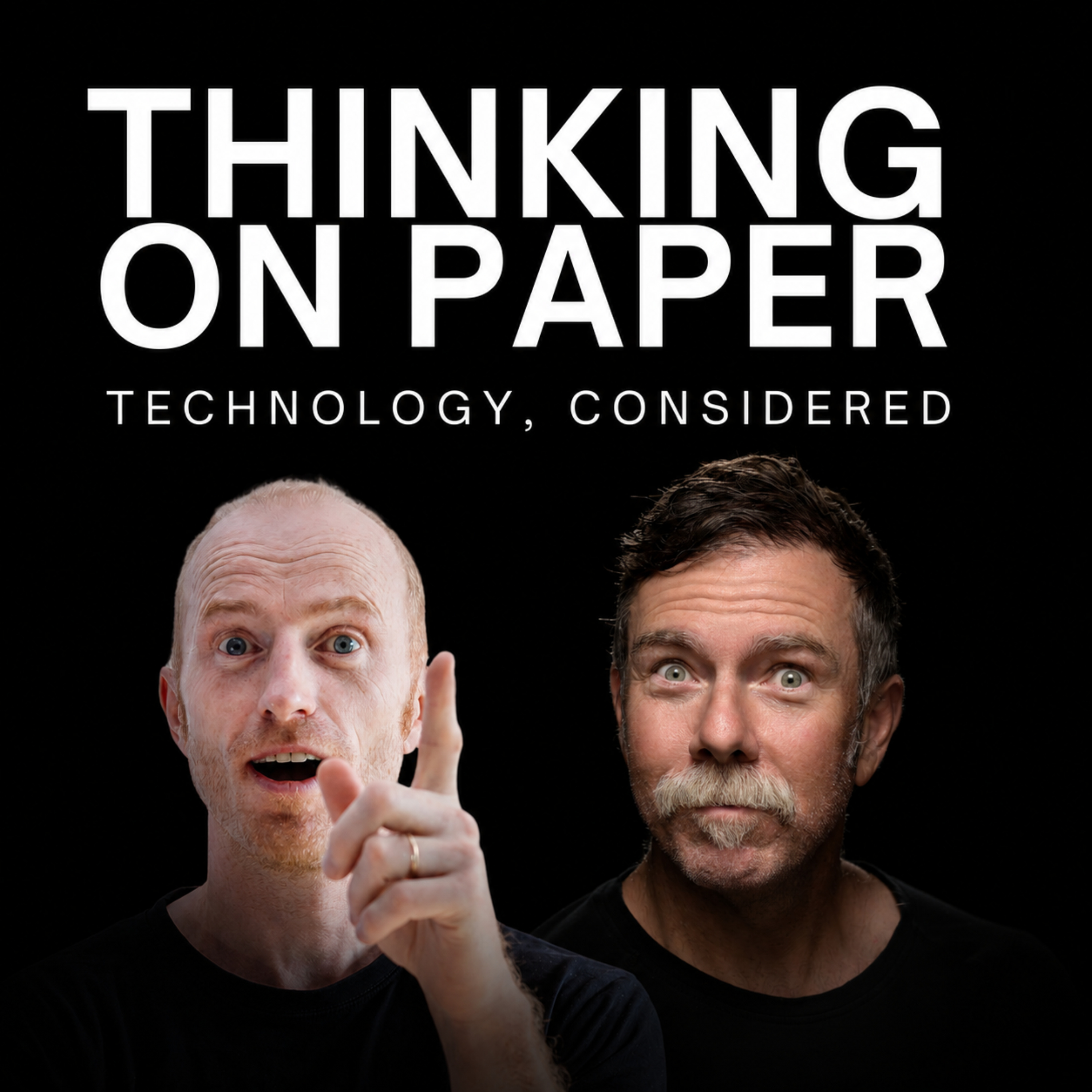
Mark Fielding and Jeremy Gilbertson
Technology, Connected
All original. All human. Thinking On Paper is a weekly technology podcast about AI, quantum computing, robotics, space infrastructure, privacy, media, energy and the future of human life. It's a show for people who know technology is changing everything, but don’t trust the hype merchants, doom merchants, or LinkedIn prophets to explain it. Every week, Mark Fielding and Jeremy Gilbertson speak to founders, CEOs, scientists, writers, philosophers and outliers about the technologies reshaping business, society, work, creativity, politics and power. For curious minds.
Autor
Mark Fielding and Jeremy Gilbertson
Kategorie
Podcast-Website
Neueste Folge
8. Jul 2026
Wo hören?
Podcasts in der App Replaio Radio Bald verfügbarPodcasts kommen bald in die App. Installiere sie jetzt und erlebe als Erster einen ganz neuen Blick auf Podcasts
 Kostenlos installieren
Android 5 Mio.+ Downloads · Bewertung 4,8
iOS bald
Kostenlos installieren
Android 5 Mio.+ Downloads · Bewertung 4,8
iOS bald
Folgen
The Star That Fooled Astronomers 26.11.2025 9:55
What makes neutron stars so fascinating that they once fooled astronomers into thinking they were aliens? 1967: PhD student Jocelyn Bell Burnell discovers repeating radio pulses from space using a homemade array of wooden poles and copper wire. Regular. Precise. Unnatural. They called it LGM-1. Little Green Men. It wasn't aliens. It was something stranger: neutron stars. The densest objects in the...
AI At The Wheel: Why You Shouldn't Be Driving 24.11.2025 3:36
Everyone thinks they're a great driver. They're wrong. Most drivers think they can judge a safe overtake. They can't. And that's why we crash. Barry Lunn breaks down the sensor technology that sees eight cars ahead, detects velocity before brake lights appear, and intervenes when you're about to make a mistake. The tech: Radar. Not cameras. Not lidar. Millimeter-wave signals that bounce around tra...
Build Your Own Quantum Computer 22.11.2025 5:20
What if someone handed you the recipe for a quantum computer? Coleman Collins of IonQ breaks down DiVincenzo's criteria—the five capabilities any system needs to be a quantum computer. Physicist David DiVincenzo created the checklist. Every major quantum architecture (superconducting circuits, trapped ions) follows it. The five requirements: 1. A well-defined qubit (your basic unit of quantum info...
Your Laptop Would Die in Space 21.11.2025 42:53
Radiation-hardened electronics don't get headlines. But nothing in orbit works without them. Starship, ISS, Starlink, Project Kuiper—all depend on hardware that survives what would kill your laptop in seconds. Danny Andreev, CEO of Sunburn Schematics, designs systems for real space missions. He explains what keeps spacecraft alive. The threats: - Radiation (particles flip bits, corrupt memory, fry...
He Saved Humanity From Nuclear War 20.11.2025 4:33
September 26, 1983. Soviet bunker. Lieutenant Colonel Stanislav Petrov watches computers say US nuclear missiles are incoming. The data says: Launch. His intuition says: Wait. Petrov overrides the system. Saves the world. If AI had been in charge, everyone would be dead. Mark and Jeremy use the Petrov story to explore Federico Faggin's argument in *Irreducible*: information is not the same as cons...
Our Last Design Choice 19.11.2025 6:42
We speak to Don Norman about humanity centered design. The godfather of design explains why we need Humanity-Centered Design—a shift from individual users to society, planet, and long-term impact. The problem: "What's wrong is what's left out." Every digital product relies on physical infrastructure. Power systems. Data centers. Electricity. Rare earth mining. You can't design a phone without desi...
Why Starcloud Wants To Put Data Centers In Space 18.11.2025 3:27
Philip Johnston is CEO of Starcloud. They build data centers in space. Their first satellite just launched on SpaceX Falcon 9. You can track it orbiting Earth right now. This short covers humanoid robots, data centers in orbit, and whether the future includes dancing machines. We talk about: - Why Philip predicts 5 billion humanoids by 2035 - What humanoid robots will actually do (not dance—work)...
AI Agents Are Taking Over The Internet 15.11.2025 6:54
AI agents can read feeds, make decisions, coordinate with other agents, and speak on your behalf, without you in the loop. Andrew Hill explains what agents actually are, why every company is racing to build them, and how close we are to personal agents that manage schedules, explain our thinking, and negotiate with other people's agents. We talk about: - What an AI agent actually is (beyond ch...
Why Mars Missions Need Musicians 14.11.2025 3:32
To survive in space, you don't just need engineers. You need a musician. Preferably a guitarist. Jeremy asks physicist Danny Andreev (CEO, Sunburn Schematics): Could my 1969 Fender Vibrolux amp work in space? Answer: Yes. Analog gear shrugs off radiation. What starts as electrical engineering turns into human psychology and Mars survival. We talk about: - Why Jeremy's vintage guitar amp would work...
AI Is Becoming A Franz Kafka Novel 13.11.2025 4:17
Carissa Veliz joins us again to speak about AI Ethics, a mirage straight from a Kafka novel. Questions of justice, principles and the rule of law are incompatible with machine learning. Machine learning is statistical analysis of data that outputs responses human beings are likely to find attractive, not true or ethical. That is not a good way to design ethics. Carissa Veliz joins Makr & Jerem...
AI Is Digging Up Fossil Fuels 09.11.2025 4:30
Exxon and Chevron are using Microsoft AI to extract more oil. Faster. Cheaper. The goal: every last drop. Holly and Will Alpine (Enabled Emissions) paint a stark picture with Microsoft's own numbers: Exxon deal: 50,000 barrels/day = 6.4 million tonnes CO₂/year Chevron deal: 400,000 barrels/day = 51 million tonnes CO₂/year Microsoft's entire FY23 footprint: 17 million tonnes. Carbon removal booked...
The Quantum Circus 08.11.2025 4:10
Brandon Severin (CEO, Conductor Quantum) explains spin qubits and the complex nature of quantum computing. With a lion. Take one electron. Put it in a magnetic field. It acts like a tiny compass needle with two orientations—spin-up and spin-down. Those are your 0 and 1. Isolate that electron on a gated silicon device. Hit it with precise pulses. You can flip, hold, and combine those states (superp...
Banks Don't Want You To Have Crypto 07.11.2025 3:20
Stablecoins already move more volume than Visa and Mastercard combined. There's a financial revolution in the air, and the banks don't want you involved. Robby Yung, CEO of Animoca Brands, shows how people move dollars across borders in minutes with near-flat fees, from market traders in Nigeria to institutions shifting tens or hundreds of millions. This is a short from our full length deep dive i...
Blocking China From Space May Have Backfired 06.11.2025 5:13
China built its space station Tiangong in three years after being excluded from the ISS. It landed on the Moon twice—2020 and 2024—returning samples from high helium-3 areas. Now the race is for resources and rules. Glen Martin (aerospace designer, ISS contributor) explains how China's space program connects: high-speed rail expertise at home translates to orbital infrastructure. Grid power system...
Remove The Beatles From The AI Training Data 04.11.2025 27:05
You're listening to AI-generated music and don't realize it. The musicians whose work trained those models know. They check their empty bank accounts daily. 99,000 new songs upload to streaming platforms every day. One in five are AI-generated (Deezer). You wouldn't play a single one at your funeral. 59% of musicians use AI in some aspect of their music (Ditto Music). The question: How do real mus...
Kevin Kelly Asks 13.10.2025 6:59
Kevin Kelly, one of the great technological philosophers of our time, joined Mark & Jeremy to Think on Paper. Before he left, he asked a question. A question about the future and technology: What should humans be? At the end of every show, we ask every guest this question. And the answers always resonate on an emotional, human level. They land on something universal. The same words, the same...
How To Make Money Investing In Space 08.10.2025 43:16
The space economy is set to reach $1.8 trillion by 2035. Everyone talks about rockets. Almost no one talks about the infrastructure that connects orbit to Earth. This is where billions of dollars of that space investment are being increasingly allocated. Mark Boggett runs Seraphim Investments, a London-based fund that backs the companies building the foundations of the space economy. In this conv...
How Do Kids Use ChatGPT In School? 01.10.2025 23:31
A quarter of British 8 to 12 year olds have used generative AI. ChatGPT is the most popular tool, Snapchat AI is second. Half of teachers say they've already received homework that was clearly written by AI. And 58 percent of private school kids have used AI compared to just 18 percent at state schools, which is a gap so large it's reshaping the next generation's relationship with this technology...
When Will Quantum Computers Be Able To Steal Your Bitcoin? 01.10.2025 55:10
IBM's Lory Thorpe warns that quantum computers could soon crack the encryption protecting our banks, health records, and personal data, enabling "harvest now, decrypt later" attacks that threaten global security. Through IBM's collaboration with NIST and major institutions, she's racing to develop quantum-resistant algorithms before current encryption systems become obsolete. Join hosts Mark Field...
D-Wave Quantum Computing - Behind The Scenes 01.10.2025 51:52
Murray Thom, VP of Quantum Technology Evangelism at D-Wave, joins us to break down how D-Wave’s quantum computing technology (as used by NASA, VW, Lockheed Martin) is tackling complex, high-stakes problems across industries. Learn how D-Wave’s unique use of quantum annealing helps solve real-world challenges, from logistics optimization to drug discovery and traffic management. Murray explains how...
The Surprisingly Small Rocket You Need To Build Civilization On The Moon 25.09.2025 25:48
Twelve metric tons and a SpaceX rocket. That’s all it would take to begin building industry on the Moon. Factories would rise. Humanoids would adapt. Asteroids would be mined. And within decades, the solar system could host an economy millions of times larger than Earth’s today. The catalyst is a paper by Philip Metzger, Anthony Muscatello, Robert Mueller, and James Mantovani outlining a pathway t...
Is Democratizing AI Really Possible? Rajeev Kapur 24.09.2025 29:53
A 16-year-old in Barcelona dropped out of school, fell in love with ChatGPT, and built a $2 million business selling nasal breathing strips with a single employee in the Philippines. A small-town tax company in South Carolina used AI to automate W-2 processing and is now on track to do five times its previous volume. A chef who used to spend a day rejigging menus for guests with allergies now does...
Has Kevin Kelly Changed His Mind About AI? 20.09.2025 38:24
Kevin Kelly is the most interesting man on the planet. The founder of Wired has spent the last few years asking one question: what is AI? His books have shaped how we think about innovation, the future of technology, and what works. His voice has been present at every major technological shift, from the early internet to AI today. His influence has reached all the way to this podcast. His essays a...
What Is Space Based Solar Power? 18.09.2025 7:59
For decades, the idea of harvesting solar energy from orbit belonged to science fiction. The theory was sound—collect sunlight in space and beam it to Earth as microwave energy—but the cost of launch, assembly, and control made it impossible to justify. Today, those constraints have changed. Reusable rockets, autonomous robotics, and modular design have pulled the concept from imagination into pro...
Don Norman Issues His Final Warning To Humanity 18.09.2025 47:12
Don Norman is not happy. The same mindset that gave us convenience also gave us climate collapse, inequality, and fragile institutions. Design isn’t decoration. It’s power. It built the products we use, the systems we depend on, and the crises that now threaten us. “Human-centered” design sounds good, but it isn’t enough. Norman argues it has blinded us to bigger responsibilities , ecosystems, cul...
Ähnliche Podcasts







Höre den Podcast Technology, Connected in Replaio
Radio und Podcasts in einer App - kostenlos und ohne Anmeldung. Installiere sie noch heute und verpasse den Start nicht
Replaio ist kein Herausgeber von Podcasts; die Namen der Sendungen, Cover und Audioinhalte gehören ihren Autoren und werden über öffentliche RSS-Feeds verbreitet