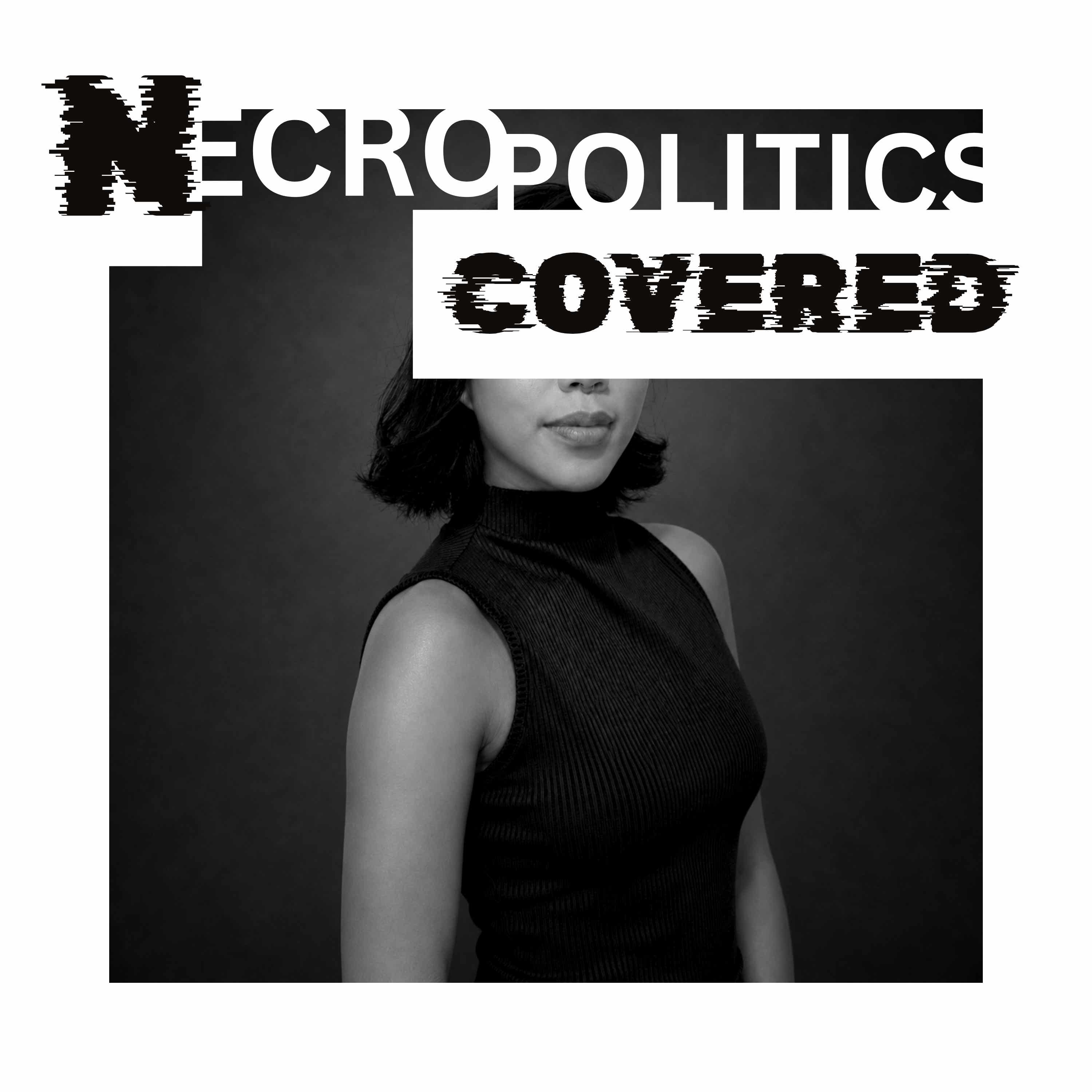
Necropolitics Covered
Covering abstracts and excerpts of academic pieces on necropolitics from all over the world. necropolitics.substack.com
Besuch unbedingt die Website des Podcasts und unterstütze die Macher: necropolitics.substack.com
Wo hören?
Podcasts in der App Replaio Radio Bald verfügbarPodcasts kommen bald in die App. Installiere sie jetzt und erlebe als Erster einen ganz neuen Blick auf Podcasts
 Kostenlos installieren
Android fast 10 Mio. Downloads · Bewertung 4,8
iOS bald
Folgen
Public penology: postcolonial biopolitics and a death in Alipur Central Jail, Calcutta 30.05.2026 1:53
Bhattacharya, B. (2009) ‘Public penology: postcolonial biopolitics and a death in Alipur Central Jail, Calcutta’, Postcolonial Studies, 12(1), pp. 7–28. doi: 10.1080/13688790802616225. Abstract: This article reads the unusual public nature of a recent event of capital punishment in India to think about the modes of postcolonial biopolitics in this age of globalization. It engages with influential...
“Racism is a perfect crime”: favela residents’ everyday experiences of police pacification, urban militarization, and prejudice in Rio de Janeiro 29.05.2026 1:34
Håndlykken-Luz, Å. (2020) ‘“Racism is a perfect crime”: favela residents’ everyday experiences of police pacification, urban militarization, and prejudice in Rio de Janeiro’, Ethnic and Racial Studies, 43(16), pp. 348–367. doi: 10.1080/01419870.2020.1800774. Abstract: This article examines residents’ everyday experiences and perceptions of changing urban politics and racism in a “pacified” favela,...
‘Causes’ versus ‘Conditions’: Imperial Sovereignty, Postcolonial Violence and the recent Re-Emergence of Arendtian Political Thought in African Studies 28.05.2026 1:47
Lee, C. J. (2008) ‘‘Causes’ versus ‘Conditions’: Imperial Sovereignty, Postcolonial Violence and the recent Re-Emergence of Arendtian Political Thought in African Studies’, South African Historical Journal, 60(1), pp. 124–146. doi: 10.1080/02582470802287752. Abstract: Since the Rwandan genocide of 1994, an increase in scholarship on genocide and mass violence has developed over the past ten years,...
Youth as Death 27.05.2026 1:20
Neely, A. H. (2024) ‘Youth as Death’, Annals of the American Association of Geographers, 114(10), pp. 2281–2296. doi: 10.1080/24694452.2024.2374922. Abstract: Since the end of apartheid, life in South Africa has been marked by an epidemic of death among the youth—people between the ages of fifteen and thirty-five. First as a result of HIV/AIDS and political violence, and more recently as a result...
‘We Want Them Alive!’: The Politics and Culture of Human Rights 26.05.2026 1:15
Fregoso, R. L. (2006) ‘‘We Want Them Alive!’: The Politics and Culture of Human Rights’, Social Identities, 12(2), pp. 109–138. doi: 10.1080/13504630600583296. Abstract: In this essay I argue that a new order of power is emerging on the US-Mexico borderlands. This order of power is necropolitical. I then analyse feminicides on the borderlands in relation to this emerging order of power. Drawing up...
Fundamentalism in Iranian Kurdistan and its others: a critical discourse analysis 24.05.2026 1:57
Salehipour, Farhad, Seyed Hossein Serajzadeh, and Kamal Khaleghpanah. 2026. “Fundamentalism in Iranian Kurdistan and Its Others: A Critical Discourse Analysis.” British Journal of Middle Eastern Studies, February, 1–21. doi:10.1080/13530194.2026.2632201. Abstract: Although Islamist movements in the Middle East share certain similarities, their diversity and divergences are closely tied to their sp...
Call and response 23.05.2026 1:13
Goldberg, D. T. (2010) ‘Call and response’, Patterns of Prejudice, 44(1), pp. 89–106. doi: 10.1080/00313220903507651. Abstract: Goldberg’s essay is an extended response to five reviews of his recent book The Threat of Race contributed by Nadia Abu El-Haj, Susan Giroux, Kelly Gillespie, Nelson Maldonado-Torres and Peter Wade. Issues discussed range over the sadistic elements of racism’s characteris...
And now the end is near: enlivening and politizising the geographies of dying, death and mourning 22.05.2026 2:18
Stevenson, O., Kenten, C. and Maddrell, A. (2016) ‘And now the end is near: enlivening and politizising the geographies of dying, death and mourning’, Social & Cultural Geography, 17(2), pp. 153–165. doi: 10.1080/14649365.2016.1152396. Abstract: A new body of scholarship on death and loss has emerged as a sub-field within social and cultural geography. This work has done much to draw geographers’...
Doing research among exiled Rwandan army deserters: a reflexive narrative 22.05.2026 1:29
Ncube, F. (2025). Doing research among exiled Rwandan army deserters: a reflexive narrative. Social Dynamics, 51(1), 97–116. https://doi.org/10.1080/02533952.2025.2593069 This paper reflects on my experiences of doing research among ex-soldiers who deserted from the post-conflict Rwandan military, who believe that they are being “hunted” by their government, allegedly, for political reasons. It at...
Transnational America: race, gender and citizenship after 9/11 21.05.2026 0:55
Grewal, I. (2003) ‘Transnational America: race, gender and citizenship after 9/11’, Social Identities, 9(4), pp. 535–561. doi: 10.1080/1350463032000174669. This paper examines the racialisation and gendering of a collective subject described as ‘Middle Eastern or Muslim’ in the US media in the aftermath of 9/11. It examines how this category came to be visible and prominent through the workings of...
Dialogues with the Dead: Necropoetics of Zahra’s Paradise 20.05.2026 0:46
Shams, F. (2020). Dialogues with the Dead: Necropoetics of Zahra’s Paradise. Iranian Studies, 53(5–6), 893–909. https://doi.org/10.1080/00210862.2019.1689809 What can the poetry chosen for epitaphs on graves tell us about the political and cultural development of post-revolutionary Iran and the politics of death and dying under the Islamic Republic? This article explores contemporary Persian epita...
“Better never means better for everyone”: White feminist necropolitics and Hulu's The Handmaid's Tale 19.05.2026 1:08
Neville-Shepard, M. (2023) ‘“Better never means better for everyone”: White feminist necropolitics and Hulu’s The Handmaid’s Tale’, Quarterly Journal of Speech, 109(1), pp. 2–25. doi: 10.1080/00335630.2022.2136738. This article builds on those who have critiqued Hulu's The Handmaid's Tale along racial lines and calls into question the esteemed status the show holds as a rhetorical resource for con...
Splintering Palestine (2005) 18.05.2026 1:50
Gregory, D., 2005. Splintering Palestine. B/ordering Space, pp.123-37. Excerpt: Topographies of Terror. Ever since 11 September 2001, the Israeli government of Ariel Sharon has taken advantage of President George W. Bush's `war on terrorism' to ratchet up the colonial dispossession of the Palestinian people (Mansour, 2002; Gregory, 2003). It has done so by seeking to establish an identity between...
Itinerant deathworlds: Spanish border externalisation and the necroborder 15.04.2026 1:00
Lopez Oggier, F. (2026). Itinerant deathworlds: Spanish border externalisation and the necroborder. Territory, Politics, Governance, 1–17. https://doi.org/10.1080/21622671.2025.2594500 Abstract: In 2006 Spain spearheaded European border externalisation, re-spatialising its border into a peripatetic political institution to systematically intercept ‘irregular’ migrants. This paper conducts a necrop...
Whose turn is it? White diasporic and transnational practices and the necropolitics of the plantation and internment camps 14.04.2026 1:14
Palombo, L., 2007. Whose turn is it? White diasporic and transnational practices and the necropolitics of the plantation and internment camps. Critical Race and Whiteness Studies, 3. Abstract: The bordering of the Plantation Camps of the 1860s and Internment Camps of World War One (WW1) through the racialised biopolitical and necropolitical relations of the state of exception have controlled local...
State of Exception, Necropolitics, and Puerto Rico: Naturalizing Disaster and Naturalizing Difference 13.04.2026 1:31
Khoshneviss, H. (2024) ‘State of Exception, Necropolitics, and Puerto Rico: Naturalizing Disaster and Naturalizing Difference’, Capitalism Nature Socialism, 35(1), pp. 75–89. doi: 10.1080/10455752.2023.2279957. Abstract: Right after Hurricane Irma hit Puerto Rico and Florida, Hurricane Maria made landfall in Puerto Rico in September 2017. Around the same time Harvey hit Texas. The vast difference...
Necropolitical complicities: (re)constructing a normative somatechnics of Iraq 12.04.2026 0:45
Citation: Osuri, G. (2009) ‘Necropolitical complicities: (re)constructing a normative somatechnics of Iraq’, Social Semiotics, 19(1), pp. 31–45. doi: 10.1080/10350330802632766. Abstract: This article theorizes the concept of necropolitical complicities in the construction and writing of ethno-sectarian identities in the context of the war in Iraq. Drawing on Mbembe's concept of necropolitics in re...
Discordant necropolitics: survivor-led exhumations and violence against the dead in the early post-Holocaust Poland 11.04.2026 0:54
Abstract: The Holocaust left behind countless bodies – bodies dispersed across the execution sites, former Nazi camps, repurposed Jewish cemeteries; bodies hastily buried at the outskirts of the former shtetls and in the forest. This article traces the early postwar attempts by various actors to respond to the material (omni)presence of dead bodies. It engages with endeavors by Jewish survivors to...
The Biopolitics of Settler Colonialism: Right Here, Right Now 10.04.2026 1:33
Morgensen, S. L. (2011) ‘The Biopolitics of Settler Colonialism: Right Here, Right Now’, Settler Colonial Studies, 1(1), pp. 52–76. doi: 10.1080/2201473X.2011.10648801. Abstract: Settler colonialism is exemplary of the processes of biopower theorised by Giorgio Agamben and Michel Foucault. However, settler colonialism remains naturalised within theories of biopower and theories of its relation to...
Between exclusion and escape: necropolitics, biopolitics, and queer narratives in Nollywood films 08.04.2026 1:04
Abstract: This research examines the representation of queer characters in Nigerian films through the lenses of necropolitics and biopolitics. Although LGBTQ+ presence in Nollywood has increased, there is a lack of scholarly focus on their experiences of internal migration and the forces impacting their lives. This study analyzes Hell or High Water, We Don’t Live Here Anymore, and Walking in Shado...
Sovereignty and necropolitics at the Line of Control 07.04.2026 1:18
Morton, S. (2014). Sovereignty and necropolitics at the Line of Control. Journal of Postcolonial Writing, 50(1), 19–30. https://doi.org/10.1080/17449855.2013.850213 Abstract: This paper considers how the sovereignty of the Indian government over Kashmir is asserted and contested around the Line of Control, and the military checkpoints that visualize such forms of sovereignty. Beginning with a disc...
Where the route ends and the new border begins: necropolitical governance and migrant resistance in the Canary Islands 06.04.2026 1:40
Abstract: This article examines the Western Atlantic migration corridor to the Canary Islands, one of Europe’s most perilous yet persistently traversed routes, through the conceptual lens of infrastructures of endurance. Drawing on fieldwork in El Hierro and Tenerife, it employs patchwork ethnography and semi-structured interviews with migrants from West Africa and the Horn of Africa. A distinctiv...
Criminal Justice as State Racism: Race-Making, State Violence, and Imprisonment in the USA, and England and Wales 05.04.2026 1:23
Abstract: This article uses Michel Foucault’s account of state racism from “Society Must Be Defended” to understand racialized violence in the criminal justice systems of the USA and England and Wales. Foucault argues that modern states make race in order to exercise the sovereign power to kill, by both directly killing racially defined groups and through “indirect murder…or, quite simply, politic...
A Necropolitical Visual Regime: Banditry in Colombia, 1958–1964 04.04.2026 1:31
Abstract: From 1958 to 1964 in Colombia, during the first years of the partisan power-sharing agreement known as the National Front, roving crews of gunmen labelled ‘bandits’ who had been mobilised and then abandoned by party elites terrorised local populations in the countryside. We track the gruesome photographic record of that violence: first, as it was produced by bandits who recruited photogr...
'From the closet into the Knesset’: Zionist sexual politics and the formation of settler subjectivity 03.04.2026 1:48
Abstract: This article examines Zionist sexual politics as a particular modality of settler colonial subject making. It analyses the inclusion of Israeli LGBTs into the state, by examining the cultural archive of Zionism, in which the colonisation of Palestine and Palestinians is constitutively inscribed and obscured. Tracing the itinerary of Israel’s LGBT movement, it looks at how the Zionist pro...
Ähnliche Podcasts






Höre den Podcast Necropolitics Covered in Replaio
Radio und Podcasts in einer App - kostenlos und ohne Anmeldung. Installiere sie noch heute und verpasse den Start nicht
Replaio ist kein Herausgeber von Podcasts; die Namen der Sendungen, Cover und Audioinhalte gehören ihren Autoren und werden über öffentliche RSS-Feeds verbreitet