iHeartPodcasts
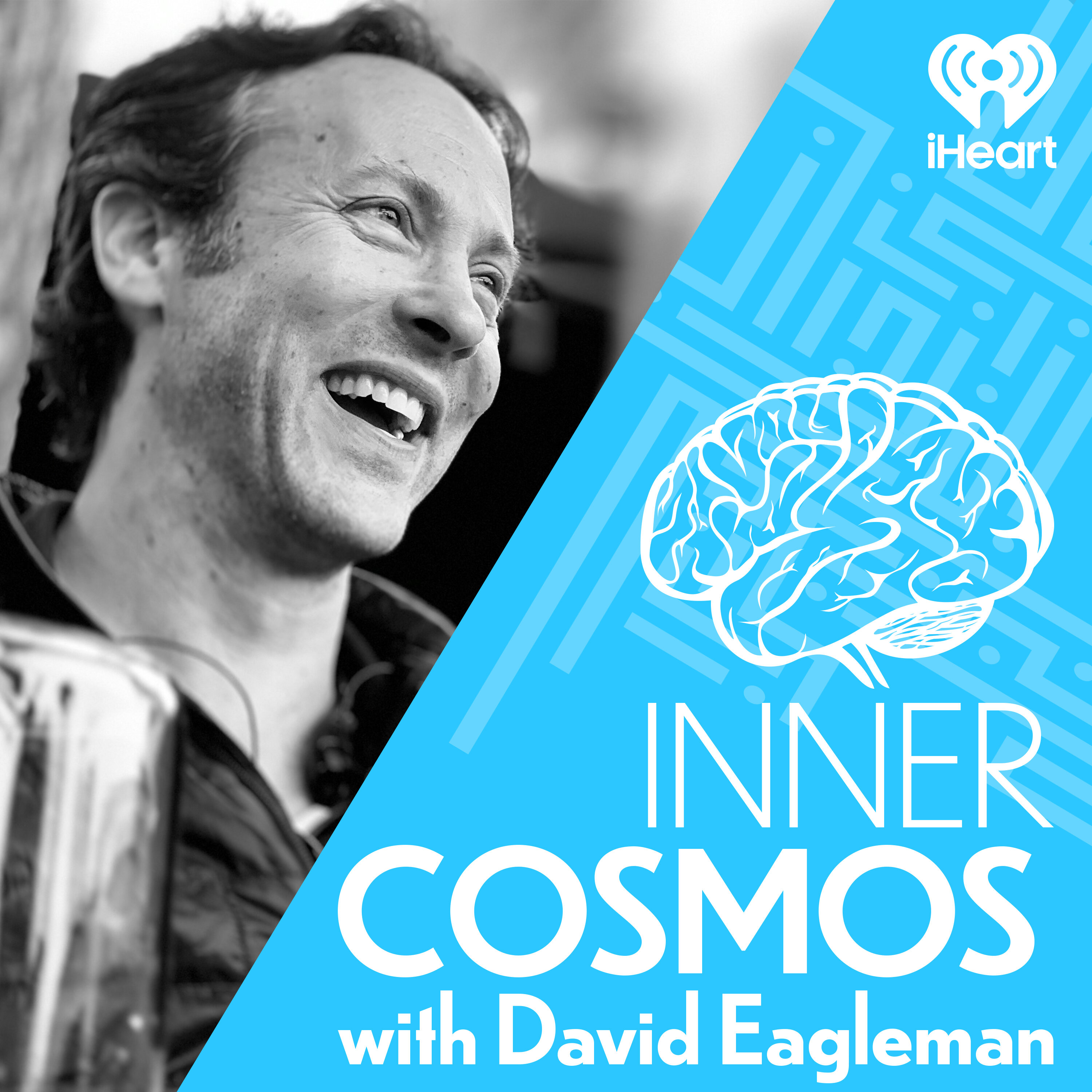
Inner Cosmos with David Eagleman
Neuroscientist and author David Eagleman discusses how our brain interprets the world and what that means for us. Through storytelling, research, interviews, and experiments, David Eagleman tackles wild questions that illuminate new facets of our lives and our realities.
Besuch unbedingt die Website des Podcasts und unterstütze die Macher: www.iheart.com
Wo hören?
Podcasts in der App Replaio Radio Bald verfügbarPodcasts kommen bald in die App. Installiere sie jetzt und erlebe als Erster einen ganz neuen Blick auf Podcasts
 Kostenlos installieren
Android fast 10 Mio. Downloads · Bewertung 4,8
iOS bald
Kostenlos installieren
Android fast 10 Mio. Downloads · Bewertung 4,8
iOS bald
Folgen
EP127 "What happens when we marry brains to machines?" with Sergey Stavisky 27.10.2025 1:00:04
What is a brain-computer interface? How can a paralyzed person use her brain to control a robotic arm? How can someone who's lost the gift of speech use brain signals to broadcast his voice again? Can we eventually restore autonomy and dignity so seamlessly that the technology disappears and the person reappears? Where are the ethical boundaries between restoring function and spying on private tho...
Ep126 "Does science fiction shape reality?" with Bethanie Maples 20.10.2025 35:39
How is sci-fi like a cultural research and development lab? Will we someday have AI agents that live in robot bodies, and will we be liable if they commit murder? What happens when reality is no longer verifiable? How can we create AI advocates that guide us toward self-actualization over distraction? What is a Young Lady's Illustrated Primer? This week we talk with researcher Bethany Maples about...
Ep125 "Why do brains need friends?" (with Ben Rein) 13.10.2025 54:54
Why do human brains need social interaction? Why might AI chatbots be insufficient to scratch the itch? What do we love so much about real human touch and in-person interaction? Why do so many of us live with dogs? From empathy to introversion to social media to isolation (and what to do about it), we’ve got it all this week with guest Ben Rein, author of the new book Why Brains Need Fr...
Ep124 "Why don't we notice gaps in time?" 06.10.2025 41:34
How is your consciousness like a flame that continually goes out and gets re-lit? Why can you see other people's eyes move, but you can't see your own eyes move in the mirror? And what does any of this have to do with deep sleep, anesthesia, comas, amnesia, and empires of soft-bodied creatures that came before us? Tune in this week for some science that will shift your view of reality.
Ep123 "Will AI cure loneliness?" with Paul Bloom 29.09.2025 40:48
On the one hand, AI companions are (increasingly) amazing at rectifying isolation. But on the other hand, loneliness is a biological signal that pushes us toward improving ourselves socially. So what's the right balance here? And does everyone have the same need to cure loneliness? In other words, might AI relationships mess up our young even while providing a critical lifeline to our se...
Ep122 "Why do we so rarely say what we mean?" (with Steven Pinker) 22.09.2025 44:01
Why do people on a date speak in innuendo? Why do dictators squelch protests? Why do humans stand apart from the rest of the animal kingdom by blushing, laughing, and crying? And what does any of this have to do with bullies, George Costanza, or cancel culture? Join this week with cognitive scientist Steven Pinker as we discuss his new book on common knowledge: “When Everyone...
Ep121 "What’s the secret to intelligence (in brains and AI)?" with Ramesh Raskar 15.09.2025 41:35
Is AI going to go the same way as computing: from colossal LLMs owned by a few companies to billions of networked AI agents? How does that parallel one of the great underappreciated secrets of the human brain? Join this week with guest MIT Media Lab professor (and AI-decentralizer) Ramesh Raskar.
Ep120 "Will AI build us into better humans?" 08.09.2025 33:37
Will AI end up building us into stronger, more talented humans? What might this have to do with linguistics, the movie Arrival, self-driving cars, debate, video games, elections, chess, and the ancient game of Go? Are we going to be taken over, or instead exposed to ideas and concepts that stretch the boundaries of our thinking? Join this week to see how AI might just up the human game.
Ep119 "Why do brains believe in the unbelievable?" with Bruce Hood 01.09.2025 36:55
Why are brains superstitious? Would you wear a nice sweater that belonged to a murderer? What does this have to do with lucky socks, ghosts, our interpretation of coincidences, why kids often need their special blankets, and what any of this has to do with the brain? Join this week with guest Bruce Hood to learn why it's so natural for brains to take incomplete data and infer causes.
Ep118 "Why has the brain always been our hardest puzzle?" with Matthew Cobb 25.08.2025 59:15
How have humans through the ages tried to crack the mysteries of the brain, and why are our theories always yoked to the most recent technologies? What does the history of brain science have to do with bumps on the skull, electricity, Frankenstein, animatronics, telegraphs, telephone exchanges, computers, and LLMs? What's the next metaphor we'll use to try to capture the brain’s magic?...
Ep117 "What does brain science have to do with free speech? (with Greg Lukianoff)" (with Greg Lukianoff) 18.08.2025 1:00:23
Most people claim to be in favor of free speech, but they often mean speech from their own side (and not whatever those crazy people on the other side want to say). But from the point of view of the brain, why does free speech need to be rigorously defended? What does this have to do with internal models, printing presses, college campuses, John Stuart Mill, online indecency, cultures of...
Ep116 " What is Color? Part 2: Why royals wear purple" 11.08.2025 37:58
Are there new colors you could see? And why are they impossible to imagine before you've seen them? Can you lose your color vision? And what does any of this have to do with linguistic color terms, why the military likes colorblind people for a particular task, and why Eagleman suggests that the cultural history of Thailand was influenced by one single, unknown neurodivergent?
Ep115 "What is color? Part 1: Why hunters wear orange" 04.08.2025 37:36
Why do birds and bees choose different flowers? Why do mammals' eyes seem to be optimized for moving around at night, and what does that have to do with hairless humans getting angry? What does any of this have to do with road signs, camouflage, mantis shrimp, the sun, the dress that broke the internet, and women who can see more colors than you can?
Ep114 "Would you eat a self burger?" 28.07.2025 36:19
Would you eat a burger grown from a human muscle cell? Would you rather use your own cell or someone else's? What does the future of lab-grown meat illuminate about neuroscience, our calculations of morality, and whether your grandchildren will have a different answer? What does any of this have to do with endangered species, the sacred versus the profane, brain plasticity, moral positioning, soci...
Ep113 "What's special about inventors?" (with Pablos Holman) 21.07.2025 57:19
Why do some people jump into entirely new categories of possibility? And what does this have to do with self-driving ships, solar panels in space, shooting mosquitoes with lasers, skateboarding tricks, silent drones, and our future as a species? Join Eagleman with guest Pablos Holman, a venture capitalist, author, and connoisseur of invention.
Ep112 "How is computer code like magic?" (with Sam Arbesman) 14.07.2025 42:44
What is code, and can it be thought of like a magic spell? Are we building a world so complex that we will lose the ability to understand its operations -- and has that already happened? What does any of this have to do with SimCity, or knowledge that already exists but no one has put together, or how coding will evolve in the near future? Join Eagleman with scientist Sam Arbesman, who has just wr...
Ep111 "Might we be surrounded with undetected minds?" (with Michael Levin) 07.07.2025 51:33
What is intelligence? If we look hard, can we find it in unexpected places: not just in brains but in all kinds of structures? How should we recognize it? And what does any of this have to do with a bipedal dog born without front legs, or making small new organisms out of single cells, or how Wikipedia might be like an axolotl, or why we are so blind to the vast variety of minds that m...
Ep110 "Is consciousness related to quantum physics?" (with Roger Penrose and Stuart Hameroff) 30.06.2025 47:42
Can we explain consciousness as emerging from classical neuroscience, or do we require deeper principles? Could quantum physics have something to do with it? Is it possible that consciousness predates biology, and biology evolved to take advantage of it? What are the right ways to build new theories in neuroscience when we don’t know the answers? Join Eagleman with Nobel laureate Roger...
Ep85 rebroadcast - "What is a Thought?" 23.06.2025 36:47
Brains bear thoughts like a peach tree bears peaches. Even for meditators it's almost impossible to stop the firehose of words and images and ideas. But what in the world is a thought, physically? How can you hear a voice in your head when there's no one speaking in the outside world? And what does any of this have to do with a small marine animal who eats its own brain? Join Eagleman for thi...
Ep109 "Are you one mind or many drives?" with Jordan Peterson 16.06.2025 42:39
Is your brain a one-person show or an ensemble cast of rivaling neural networks? How do we manage the conflict between different drives, and what does this have to do with literature, deities, maturation, and what Nietzsche meant when he said “every drive wants to be master, and it attempts to philosophize in that spirit”? Join Eagleman this week with Jordan Peterson as we examine the...
Ep108 "Can brains increase their happiness?" (with Bruce Hood) 09.06.2025 39:03
Is it possible to become happier? How much of your happiness has to do with genetics, social connection, comparison to other people, your balance of optimism vs pessimism, and whether it would be useful to keep a journal of your life? Join Eagleman this week with Bruce Hood, experimental psychologist and author of “The Science of Happiness”.
Ep107 "Why do brains love stories?" (with Joshua Landy) 02.06.2025 49:23
How do brains slip so easily from the real world into made up worlds? What do authors of great literature have in common with stage magicians and comedians? What does any of this have to do with cognitive shortcuts, prediction machines, Marcel Proust, Toni Morrison, Jane Austen, or why jokes are always structured in threes? Join Eagleman this week for a conversation with his Stanford colleague Jos...
Ep106 "What happens when brains watch movies?" (with Jeffrey Zacks) 26.05.2025 48:09
Why do movies work so well? What does film reveal about the way the brain processes reality? What does any of this have to do with omniscience, simulation, jumping around in time, or why dogs don’t do story? Join Eagleman with guest Jeffrey Zacks, cognitive scientist at Wash U, as we dive into the peculiar magic that happens when the lights go down, the screen glows to life, and we...
Ep105 "What if AI is not actually intelligent?" (with Alison Gopnik) 19.05.2025 1:10:09
Is AI an intelligent agent, or is there a different way we should be thinking about it? Is it more like a piece of cultural technology? What in the world is a piece of cultural technology -- and how would re-thinking this change our next steps? What does any of this have to do with the myth of the Golem, printing presses, Socrates, Martin Luther, or the story of stone soup? Join Eagleman this week...
Ep104 "What is your internal world really like?" (with Russell Hurlburt) 12.05.2025 42:29
If you had to give a detailed description of what flits through your mind, how good would you be at it? Might you be surprised at how many of your thoughts don't involve language? Are your thoughts changed by paying attention to them? What does this have to do with getting surprised by a random beep and immediately writing down what you’re thinking? Join Eagleman this week in conversati...
Ähnliche Podcasts








Höre den Podcast Inner Cosmos with David Eagleman in Replaio
Radio und Podcasts in einer App - kostenlos und ohne Anmeldung. Installiere sie noch heute und verpasse den Start nicht
Replaio ist kein Herausgeber von Podcasts; die Namen der Sendungen, Cover und Audioinhalte gehören ihren Autoren und werden über öffentliche RSS-Feeds verbreitet