
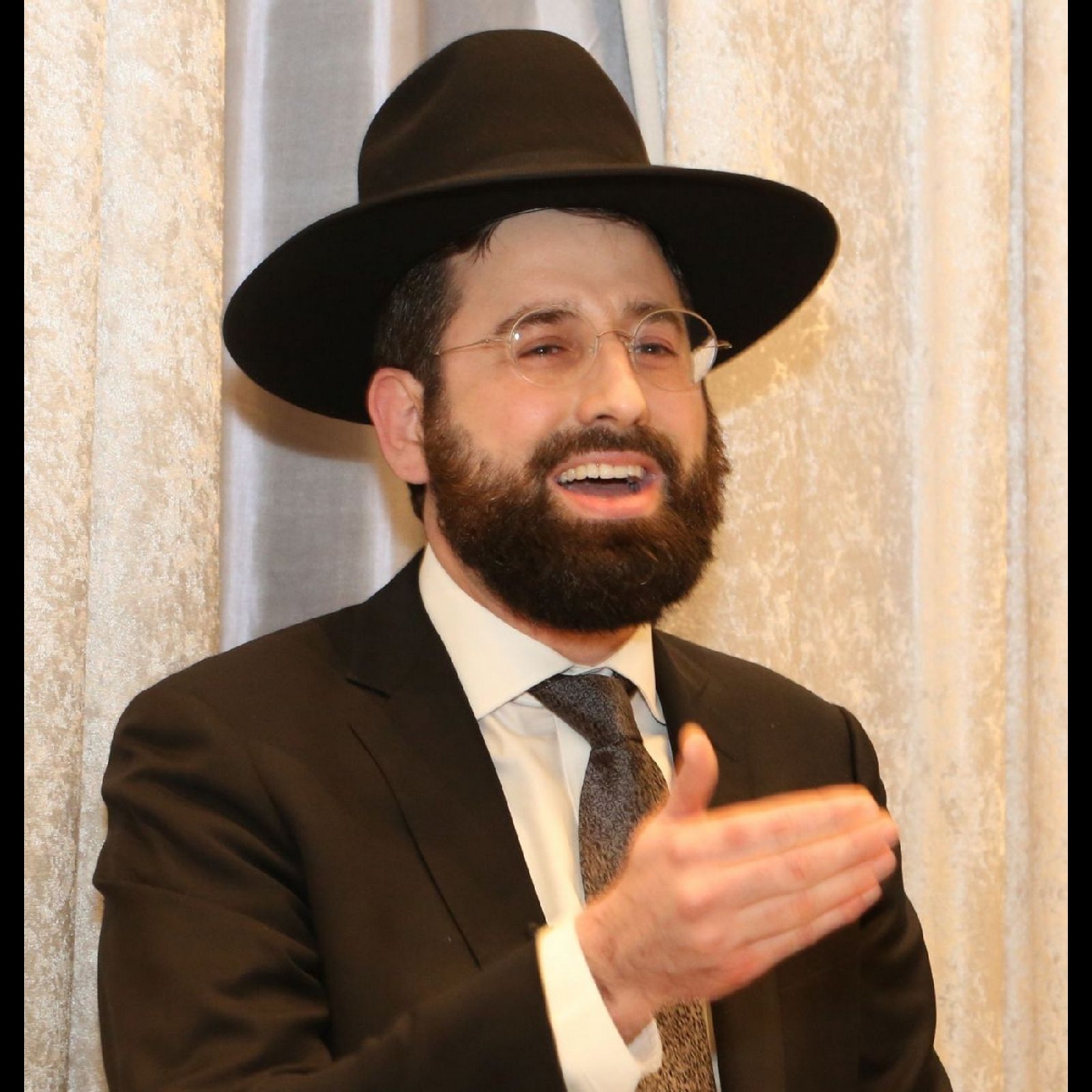
Torah Teacher Ariel ben-Lyman HaNaviy
Complete Parashah Library (Messianic)
These 105 podcast episodes represent the complete 54 Parashat HaShavua (Weekly Torah Portions) as produced by myself, Torah Teacher Ariel. Visit my home site at TetzeTorah.com for more Messianic resources. While you are there, we invite you to fill in your name and email address to subscribe to Ariel’s Weekly Messianic Newsletter to receive the written commentaries delivered to you by email, and as a bonus, you will also receive the email-exclusive written commentary to the Haftarah portion!
Besuch unbedingt die Website des Podcasts und unterstütze die Macher: www.tetzetorah.com
Autor
Torah Teacher Ariel ben-Lyman HaNaviy
Kategorie
Podcast-Website
Neueste Folge
10. Jan 2026
Wo hören?
Podcasts in der App Replaio Radio Bald verfügbarPodcasts kommen bald in die App. Installiere sie jetzt und erlebe als Erster einen ganz neuen Blick auf Podcasts
 Kostenlos installieren
Android fast 10 Mio. Downloads · Bewertung 4,8
iOS bald
Kostenlos installieren
Android fast 10 Mio. Downloads · Bewertung 4,8
iOS bald
Folgen
18 Mishpatim (Part A) - Rulings - Exodus 21:1-24:18 10.01.2026 31:03
HaShem masterfully designed his Torah to permeate every single facet of human existence, from birth, to the grave. His people were to saturate themselves with his rich mercy, grace, loving-kindness, forgiveness, and judgment, as they carefully followed each and every mitzvah (command) of the Torah. Being raised in such a "Torah-Community" had its definite advantages. This type of community produce...
18 Mishpatim (Part B) - Rulings - Exodus 21:1-24:18 10.01.2026 30:01
Chapter 21 – Verses 22-27 speak about restitution in the event of accidental injury. We are familiar with the saying, "An eye for an eye; a tooth for a tooth." We remember that our LORD Yeshua made a comment about this in the B'rit Chadashah book of Mattityahu 5:38-42. Chapter 22 – Verses 21-27 show us the compassionate heart that God has towards those less fortunate in our community. The widow, o...
18 Mishpatim (Part C) - Rulings - Exodus 21:1-24:18 10.01.2026 31:57
In our current portion, everything was sprinkled with blood. The book of Hebrews informs us that, in accordance to the Torah, almost everything is purified with blood. This ceremony was performed on the earthly copies; Yeshua's is that effectual, atoning blood sprinkled on the heavenly originals! To be sure, Hebrews goes on to say that without the shedding of blood there is no forgiveness of sin!...
19 T'rumah - Contribution - Exodus 25:1-27:19 10.01.2026 54:18
I want to develop the “temporary dwelling place” theme for our study. From this commentary, the reader will soon see that there is a lot of “Messianic redemptive history” tied up in the concept of “dwelling”. HaShem has had a grand plan of becoming the one and only God of his people, from the beginning of history. Having said that, I will work from a basic outline this time. Let’s examine my main...
20 Tetzaveh (Part A) - You are to order - Exodus 27:20-30:10 10.01.2026 36:48
The detailed account of the Tabernacle and its functions begins with a recount of the maintenance of the Menorah (Lamp Stand) that was found in the Holy Place. This lamp, if you will remember from last week's reading, was formed from a solid piece of pure gold. It is believed that this lamp weighed as much as sixty-six pounds! This was no light structure (pardon the pun). The menorah easily symbol...
20 Tetzaveh (Part B) - You are to order - Exodus 27:20-30:10 10.01.2026 23:46
In chapter 29 of our current portion, we catch a glimpse of the importance of blood sacrifice. Our God is a God of covenants. His covenants are ratified with the shedding of blood. The old Christian hymnal says it all: "There's power in the blood!" Actually, the reason that there is "power" in the blood is because the Torah explicitly teaches that there is "life" in the blood. The Torah paints a p...
21 Ki Tissa (Part A) - When you take - Exodus 30:11-34:35 10.01.2026 21:53
Chapter 31 1-11 I have singled out B'tzal'el the son of Uri the son of Hur, of the tribe of Y'hudah and his assistant Oholi'av the son of Achisamakh, of the tribe Dan. These men were supernaturally gifted to oversee the construction of the fore-mentioned Mishkan (Tabernacle) and its furniture. The lesson is obvious: when HaShem sends his people to perform a task, he will also equip them with the n...
21 Ki Tissa (Part B) - When you take - Exodus 30:11-34:35 10.01.2026 16:47
Along with the fact that it is a memorial of Creation, the Sabbath day is also an identification of HaShem's authority. Only he could set a day apart as holy (read B'resheet 2:1-3). Only he could sanctify a day as an eternal memorial of his uniqueness. No other created being has this authority. This includes man. This includes religious institutions. When we attempt to override this authority, we...
21 Ki Tissa (Part C) - When you take - Exodus 30:11-34:35 10.01.2026 45:04
Chapter 34 5-7 This is the famous "Thirteen Attributes of Mercy", of HaShem, as identified by the sages. The ministry of which I was a former writer, First Fruits of Zion, has this to say about these attributes: "The Lord, the Lord God, merciful and gracious, longsuffering, and abundant in goodness and truth, keeping mercy for thousands, forgiving iniquity and transgression and sin, and that will...
22 Vayak'hel (Part A) - He assembled - Exodus 35:1-38:20 10.01.2026 32:53
As I stated in a previous parashah, God's system of animal sacrifices was never intended to be a permanent one. In fact the etymological background of the word Torah (the root word being an archery term meaning to “direct towards the goal”) also suggests that the fullest measure of HaShem’s forgiveness was not found in the earthly copies, but rather, in the heavenly originals. Yet, during the time...
22 Vayak'hel (Part B) - He assembled - Exodus 35:1-38:20 10.01.2026 19:37
The "Old Testament" saints were not "saved" by a different system than the one in which we rely on. If they were, then this would suggest that there were really two separate ways unto righteousness—a theory, which we know, cannot be true. To be sure, Yeshua himself stated emphatically that he was THE way, and that NO man can come unto the Father except through HIM. The sacrifices, performed with a...
23 P'kudei - Accounts - Exodus 38:21-40:38 10.01.2026 50:38
With Parashat P’kudei (say “P-koo-day”) we have reached our final parashah of the book of Sh’mot (Exodus). Remember that I’ve explained to you that the word “sh’mot” is the plural form of the Hebrew word “shem” which means, “name”. We’ve discussed some pretty significant names in the book of Sh’mot. The parashah is relatively short, like it’s previous portion, and is read with Parashat Vayak’hel i...
24 Vayikra (Part A) - He called - 1:1-5:26 10.01.2026 39:48
As I stated in a previous parashah, God's system of animal sacrifices, with their ability to cleanse or “wash” the flesh, was never intended to be a permanent one. Conversely, the animal sacrifices were not intended to be a “temporary fix” either. In fact the etymological background of the word Torah (the root word being an archery term meaning to “direct towards the goal”) also suggests that the...
24 Vayikra (Part B) - He called - 1:1-5:26 10.01.2026 1:01:01
With the tamid explained we are better poised to examine the remaining five offerings of Leviticus chapters 1-5. These five are the types of offerings introduced in the opening pages of Leviticus: 'Olah (Burnt Offering) – Lev. 1:1-17 Minchah (Grain Offering) – Lev. 2:1-16 Sh’lamim (Peace Offering) – Lev. 3:1-17 Chata’at (Sin Offering) – Lev. 4:1-35; 5:1-13 ‘Asham (Guilt Offering) – Lev. 5:14-26 Th...
24 Vayikra (Part C) - He called - 1:1-5:26 10.01.2026 19:06
HaShem’s intent is to draw us close to him in genuine, loving fellowship. To this end, he has designed the entire flow of the Torah to lead us to the goal of developing the kind of trusting faithfulness that produces obedience and surrender to his Son, Yeshua HaMashiach! In the Torah, we see that a broken and contrite heart is the seedbed that will produce such a trust in HaShem. The sacrifices ma...
25 Tzav (Part A) - Give an order - Leviticus 6:1-8:36 10.01.2026 49:09
The Torah promises that when we surrender to the Ruach HaKodesh and become living vessels to be used for his glory, that he places the Torah on our inward parts—our hearts! Yeshua described us as the “Light for the world” (read Matt. 5:14-16)! What a blessed description of our spiritual function, given at the mouth of the Source of all Light—the Messiah himself! When we allow his Light to be kindl...
25 Tzav (Part B) - Give an order - Leviticus 6:1-8:36 10.01.2026 44:42
And who were Moshe and Aharon? Why, they were the very ones standing before the people now being demonstrated as HaShem’s anointed chosen ones! I’m sure that the golden calf incident wasn’t completely erased from the memories of these two great leaders, or from the people as well. Imagine what they must’ve been thinking that day! Were they perfect? Far from it! Would they yet make serious mistakes...
26 Sh’mini (Part A) - Eighth - Leviticus 9:1-11:47 10.01.2026 35:35
Here in the pages of our text, we find in no uncertain terms, the definition of what is "food" and what is "not food.” We also find the counterpart to our peculiar word "tamei.” It is the Hebrew word "tahor", translated as "clean.” Going back to our hermeneutic principle of context, these concepts of "tamei" and "tahor," as outlined in Leviticus chapter 11, fall right in the middle of a series of...
26 Sh’mini (Part B) - Eighth - Leviticus 9:1-11:47 10.01.2026 26:36
In Mark chapter 7 we don’t find Yeshua abrogating the Torah, or superceding previously stated commands with his own doctrine. Let us look at a few more verses from this passage. 18 And He said to them, “Are you so lacking in understanding also? Do you not understand that whatever goes into the man from outside cannot defile him, 19 because it does not go into his heart, but into his stomach, and i...
26 Sh’mini (Part C) - Eighth - Leviticus 9:1-11:47 10.01.2026 54:11
The Torah of Moshe never prohibits Jews from “keeping company” or “coming unto one of another nation.” This statement of Kefa’s reflects the “ethnocentric Jewish exclusivism” baggage that the Torah communities of his day had engineered, baggage not uncommon among people groups who are marginalized. In other words, Kefa was just regurgitating the standard mantra of his day. This did not excuse his...
26 Sh’mini (Part D) - Eighth - Leviticus 9:1-11:47 10.01.2026 30:29
Romans 14:14-17 Again, as with the passage in Acts, a knowledge of the social setting as well as the original Greek words will unlock the secrets to a proper understanding of this passage. Firstly the Greek word “akathartos” is not found in this passage at all. Remember, akathartos conveys that which is intrinsically unclean. Sha'ul is not discussing the issue of pork vs. lamb. The word Sha'ul opt...
27 Tazria - She conceives - Leviticus 12:1-13:59 10.01.2026 38:31
Chapters thirteen and fourteen discuss the topic of what is commonly called leprosy. The exact Hebrew word “tzara’at” is used over twenty times in these two passages alone. The word is used to describe an infectious skin disease. In most cases, the skin disease renders the inflicted person “tamei,” that is ritually impure. The instructions given to the priests is to examine the individual, and if...
28 M’tzora - Person afflicted with [leprosy] - Leviticus 14:1-15:33 10.01.2026 49:01
Allow me to make a midrash on the current parashah. When a person afflicted with tzara’at was recognized as such, he was banished to a place “outside of the camp” (see Vayikra 13:45; 14:3) until he could be examined by the cohen and thus receive the announcement of “tahor”. Today, we don’t really encounter too many within our midst of believers (remember, the unclean individual came from among the...
29 Acharei Mot (Part A) - After the death - Leviticus 16:1-18:30 10.01.2026 31:29
As I stated in a previous parashah, God's system of animal sacrifices, with their ability to cleanse or “wash” the flesh, was never intended to be a permanent one. Conversely, the animal sacrifices were not intended to be a “temporary fix” either. In fact the etymological background of the word Torah (the root word being an archery term meaning to “direct towards the goal”) also suggests that the...
29 Acharei Mot (Part B) - After the death - Leviticus 16:1-18:30 10.01.2026 1:05:07
Q: How do Jews obtain forgiveness without sacrifices? A: Forgiveness is obtained through repentance, prayer and good deeds. In Jewish practice, prayer has taken the place of sacrifices. In accordance with the words of Hosea, we render instead of bullocks the offering of our lips (Hosea 14:3) (please note: the KJV translates this somewhat differently). While dedicating the Temple, King Solomon also...
Ähnliche Podcasts







Höre den Podcast Complete Parashah Library (Messianic) in Replaio
Radio und Podcasts in einer App - kostenlos und ohne Anmeldung. Installiere sie noch heute und verpasse den Start nicht
Replaio ist kein Herausgeber von Podcasts; die Namen der Sendungen, Cover und Audioinhalte gehören ihren Autoren und werden über öffentliche RSS-Feeds verbreitet
