Jason Edwards
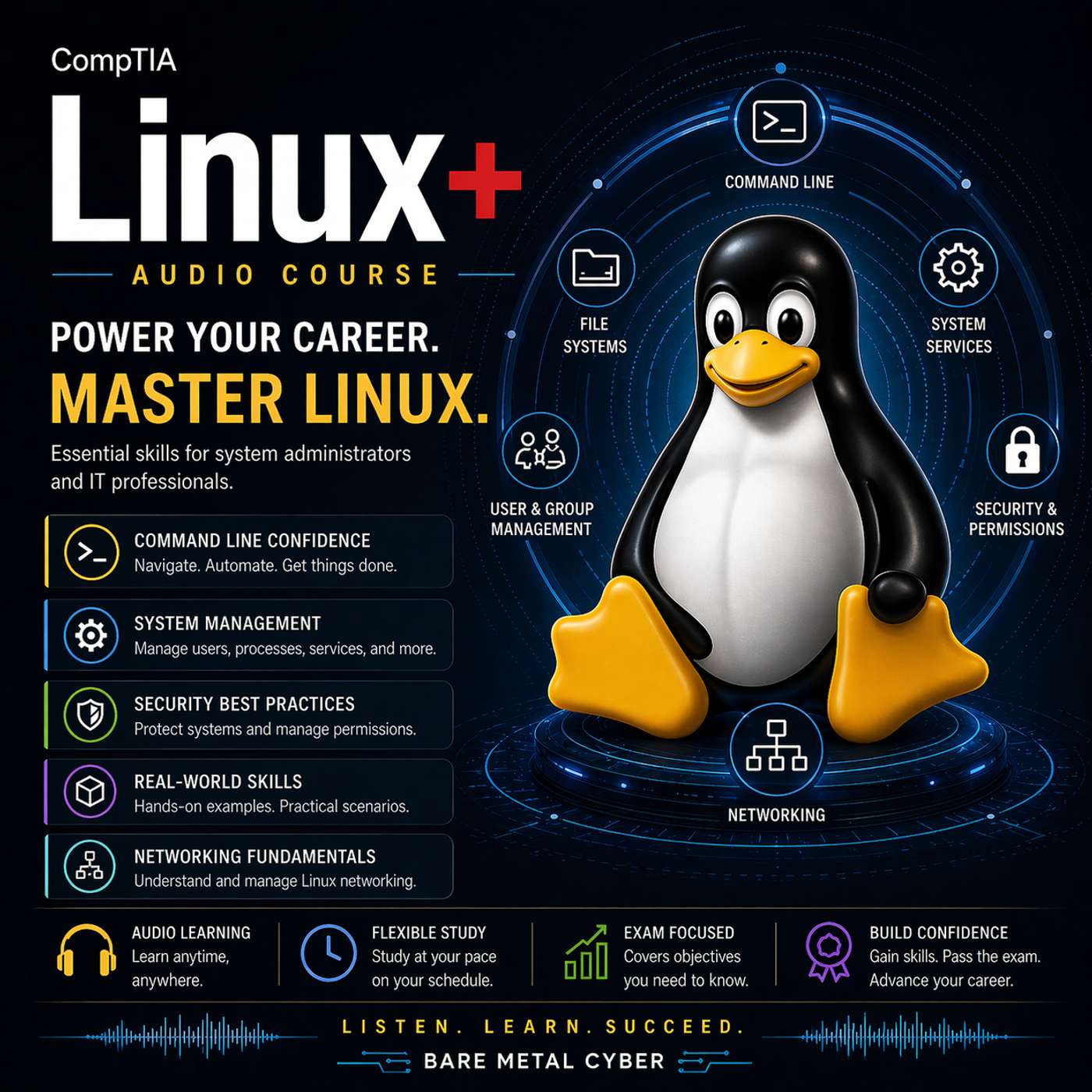
Certified: The CompTIA Linux+ Audio Course
Linux+ for People With Jobs is a practical, audio-first course that teaches you to think and work like a real Linux administrator—without burying you in theory or trivia. You’ll learn the commands, concepts, and workflows the exam expects, but more importantly, you’ll build the habits that keep systems stable in production: verifying assumptions, making safe changes, and troubleshooting with a calm, repeatable process. Every episode is designed to help you study efficiently, retain what matters, and walk into the exam with confidence that actually transfers to the job.
Wo hören?
Podcasts in der App Replaio Radio Bald verfügbarPodcasts kommen bald in die App. Installiere sie jetzt und erlebe als Erster einen ganz neuen Blick auf Podcasts
 Kostenlos installieren
Android 5 Mio.+ Downloads · Bewertung 4,8
iOS bald
Kostenlos installieren
Android 5 Mio.+ Downloads · Bewertung 4,8
iOS bald
Folgen
Episode 81 — Functions and IFS/OFS: why scripts break on spaces and how to avoid it 07.02.2026 13:29
Linux+ tests scripting reliability, and functions plus field separators are where many real-world scripts fail in subtle ways. This episode explains functions as reusable blocks that reduce duplication, improve readability, and make error handling more consistent, especially when scripts grow beyond a few lines. You’ll learn why IFS (Internal Field Separator) matters: it controls how the shell spl...
Episode 80 — Loops: for, while, until with real admin-style use cases 07.02.2026 16:22
Loops are a Linux+ staple because they represent scalable administration: you apply a consistent operation to many files, users, hosts, or checks without manual repetition. This episode explains for, while, and until as different loop types selected by intent: for iterates over a set of values, while repeats as long as a condition remains true, and until repeats until a condition becomes true, whi...
Episode 79 — Conditionals: if, case, string vs numeric comparisons, common test flags 07.02.2026 17:08
Linux+ tests conditionals because automation depends on making correct decisions with correct comparisons, and the exam often uses subtle differences to see if you understand what is being evaluated. This episode explains if and case as two ways to branch logic: if evaluates conditions and runs blocks based on true or false, while case matches patterns and is often safer for discrete values and kn...
Episode 78 — Expansion and substitution: variables, quoting, subshells, command substitution 07.02.2026 18:00
Expansion rules are high-yield on Linux+ because many scripting and command-line failures come from misunderstanding how the shell transforms text before a command runs. This episode explains variable expansion, command substitution, and subshell behavior in plain operational terms: the shell expands variables and substitutions first, then performs splitting and globbing unless you control it with...
Episode 77 — Bash script structure: shebang, execution, safety defaults, readability 07.02.2026 15:11
Linux+ tests Bash scripting because automation is a core Linux skill, and the exam expects you to write or reason about scripts that behave predictably. This episode explains script structure starting with the shebang, which defines how the script is interpreted, and moving to execution mechanics like permissions, invocation patterns, and the difference between running a script and sourcing it. Yo...
Episode 76 — Orchestration overview: Kubernetes objects plus Swarm and Compose mental models 07.02.2026 16:21
Linux+ includes orchestration because modern workloads often run as distributed containers, and administrators must understand how desired state is defined and maintained across multiple nodes. This episode introduces orchestration as the layer that schedules workloads, manages scaling, handles restarts, and coordinates networking and storage beyond a single host. You’ll learn Kubernetes objects i...
Episode 75 — CI/CD and GitOps: pipelines, shift-left testing, DevSecOps vocabulary 07.02.2026 16:31
Linux+ tests CI/CD and GitOps vocabulary because modern Linux administration often happens through pipelines, not through manual terminal changes, and the exam expects you to understand the operational implications. This episode explains pipelines as automated stages that build, test, and deploy changes, and it frames GitOps as the approach where the desired state lives in version control and depl...
Episode 74 — OpenTofu and Terraform concepts: providers, resources, state, drift, APIs 07.02.2026 16:09
Linux+ includes Terraform-style concepts because declarative provisioning has become a standard pattern, and the exam emphasizes the mental model more than brand-specific detail. This episode explains providers as the connectors to external APIs, resources as the described infrastructure objects, and state as the record of what has been created and what is expected to exist. You’ll learn why drift...
Episode 73 — Puppet at exam depth: classes, modules, facts, certificates, agent vs agentless 07.02.2026 19:08
Linux+ covers Puppet concepts because configuration management is a core enterprise skill, and the exam expects you to recognize how agent-based systems differ from agentless approaches. This episode explains Puppet at exam depth: modules package reusable configuration, classes define how resources should be applied, and facts provide host-specific data that enables conditional behavior. You’ll le...
Episode 72 — Ansible at exam depth: inventories, playbooks, modules, ad hoc, facts, agentless 07.02.2026 17:32
Linux+ tests Ansible concepts because it represents a common, practical approach to configuration management and automation in Linux environments. This episode explains Ansible at exam depth: inventories define managed hosts and groups, playbooks describe desired tasks in an ordered, repeatable way, modules provide purpose-built actions that reduce scripting risk, and ad hoc commands enable quick...
Episode 71 — IaC overview: what problems it solves and how exams describe it 07.02.2026 17:51
Linux+ includes Infrastructure as Code (IaC) because modern operations depends on repeatability, traceability, and the ability to rebuild systems reliably under change pressure. This episode frames IaC as a response to common operational pain: manual configuration drift, inconsistent environments, and deployments that cannot be reproduced when something breaks. You’ll learn how the exam describes...
Episode 70 — Integrity and destruction: AIDE, rkhunter, verification, secure erase, supply chain, banners 07.02.2026 18:04
Linux+ tests integrity and secure destruction because security is not only about preventing access, but also about proving trust and eliminating data safely when required. This episode introduces integrity verification as a concept: you establish a known-good baseline and then detect unexpected changes that could indicate tampering, compromise, or operational drift. You’ll learn exam-level roles f...
Episode 69 — Vulnerability and standards thinking: CVE/CVSS, OpenSCAP, CIS Benchmarks 07.02.2026 15:00
Linux+ includes vulnerability and standards thinking because administrators must connect technical findings to risk decisions and repeatable hardening baselines. This episode explains CVEs as identifiers for known vulnerabilities and CVSS as a scoring approach that helps prioritize remediation, while emphasizing exam-relevant nuance: severity is not the same as risk, and environment context matter...
Episode 68 — Data in transit and certs: TLS stacks, WireGuard basics, hashing, weak algorithms 07.02.2026 14:35
Linux+ tests data-in-transit protections because secure connectivity depends on understanding encryption, identity, and integrity in practical operational terms. This episode explains TLS as a stack that provides confidentiality and authentication through certificates, and it introduces WireGuard basics as a modern VPN approach that secures traffic between endpoints with a simpler operational mode...
Episode 67 — Data at rest: GPG vs LUKS2, keys, and what good enough means 07.02.2026 14:22
Linux+ includes data-at-rest protection because administrators must understand where encryption is applied and what is actually being protected. This episode compares GPG-style file encryption to LUKS2-style block device encryption as two different layers with different operational implications. You’ll learn the core exam distinction: GPG protects individual files or artifacts and is often used fo...
Episode 66 — Safer accounts: restricted shells, avoiding root habits, practical guardrails 07.02.2026 14:30
Linux+ tests account hardening because real security posture is often decided by everyday habits: who logs in, what they can run, and how privilege is handled. This episode explains restricted shells as guardrails that limit interactive capabilities, reduce accidental damage, and constrain what a non-admin account can do even if it has credentials. You’ll learn why the exam cares about avoiding ro...
Episode 65 — Password policies and lockouts: complexity, history, pam_tally2 concepts 07.02.2026 14:30
Password policy and lockout controls show up on Linux+ because they tie together authentication strength and operational resilience. This episode explains complexity rules and password history as mechanisms that reduce guessability and prevent rapid reuse, and it frames lockouts as controls that limit online guessing by temporarily blocking accounts after repeated failures. You’ll learn how the ex...
Episode 64 — SELinux and secure access: contexts, booleans, plus SSHD hardening and fail2ban themes 07.02.2026 15:56
Linux+ includes SELinux because it adds mandatory access controls that can block actions even when traditional permissions look correct, and the exam expects you to reason about denials without disabling security. This episode introduces SELinux as a context-based policy system: files, processes, and ports have labels, and access decisions are based on those labels in addition to UID/GID permissio...
Episode 63 — Permissions and control: chmod, chown, special bits, umask, ACLs, file attributes 07.02.2026 13:31
Linux+ tests permissions because they are the day-to-day control plane of a Linux system, and subtle distinctions determine whether access is secure or broken. This episode explains chmod and chown as the basic tools for setting mode bits and ownership, then expands into special bits that alter execution and directory behavior, umask as the default permission filter for newly created files, and AC...
Episode 62 — Sudo and privilege: sudoers structure, safe delegation, common misconfig patterns 07.02.2026 16:07
Sudo is a high-yield Linux+ topic because it represents controlled privilege delegation, and many security failures are caused by sloppy sudoers design. This episode explains sudo as an authorization mechanism that grants specific privileged actions without requiring full-time root access, and it introduces sudoers structure as a policy language: who can run what, as which user, from which hosts,...
Episode 61 — NAT and forwarding: DNAT, SNAT, PAT, ip_forward, troubleshooting frames 07.02.2026 15:54
Linux+ tests NAT and forwarding because they are foundational to making Linux act as a router, gateway, or service exposure point, and misunderstandings create hard-to-diagnose connectivity failures. This episode explains DNAT as destination translation used for inbound redirection, SNAT as source translation used for outbound identity changes, and PAT as the practical “many-to-one” port-based for...
Episode 60 — Netfilter concepts: iptables, nftables, ipset, stateful thinking, rule intent 07.02.2026 15:02
Linux+ includes Netfilter concepts because firewall behavior is ultimately about how the kernel processes packets, regardless of which front-end tool you use. This episode explains iptables and nftables as rule management approaches for Netfilter, and introduces ipset-style thinking as a way to manage groups of addresses or ports efficiently without writing repetitive rules. You’ll learn what “sta...
Episode 59 — Logging pipeline: journald, rsyslog, logrotate, how logs stay useful 07.02.2026 14:40
Logging is tested on Linux+ because logs are the primary evidence source for troubleshooting, security monitoring, and operational accountability. This episode describes the logging pipeline as a flow: journald collects and indexes structured logs from systemd-managed services and the kernel, rsyslog provides traditional syslog-style routing and forwarding, and logrotate manages retention by rotat...
Episode 58 — Audit basics: what auditd is for, and what audit rules capture 07.02.2026 14:20
Linux+ includes audit basics because operational security depends on being able to answer “who did what, when, and how,” using evidence the system can produce. This episode introduces auditd as the Linux auditing subsystem that records security-relevant events based on rules, capturing details that are more structured and intentional than general application logs. You’ll learn the exam-level purpo...
Episode 57 — ufw approach: rule intent, common mistakes, and why it blocks traffic 07.02.2026 13:56
ufw appears on Linux+ as an approachable firewall interface that still requires you to think clearly about traffic direction and scope. This episode explains ufw as an intent-driven wrapper that manages underlying firewall rules, focusing on the core exam skill: translate a requirement into a precise allow or deny decision that matches protocol, port, and direction. You’ll learn how questions ofte...
Ähnliche Podcasts







Höre den Podcast Certified: The CompTIA Linux+ Audio Course in Replaio
Radio und Podcasts in einer App - kostenlos und ohne Anmeldung. Installiere sie noch heute und verpasse den Start nicht
Replaio ist kein Herausgeber von Podcasts; die Namen der Sendungen, Cover und Audioinhalte gehören ihren Autoren und werden über öffentliche RSS-Feeds verbreitet