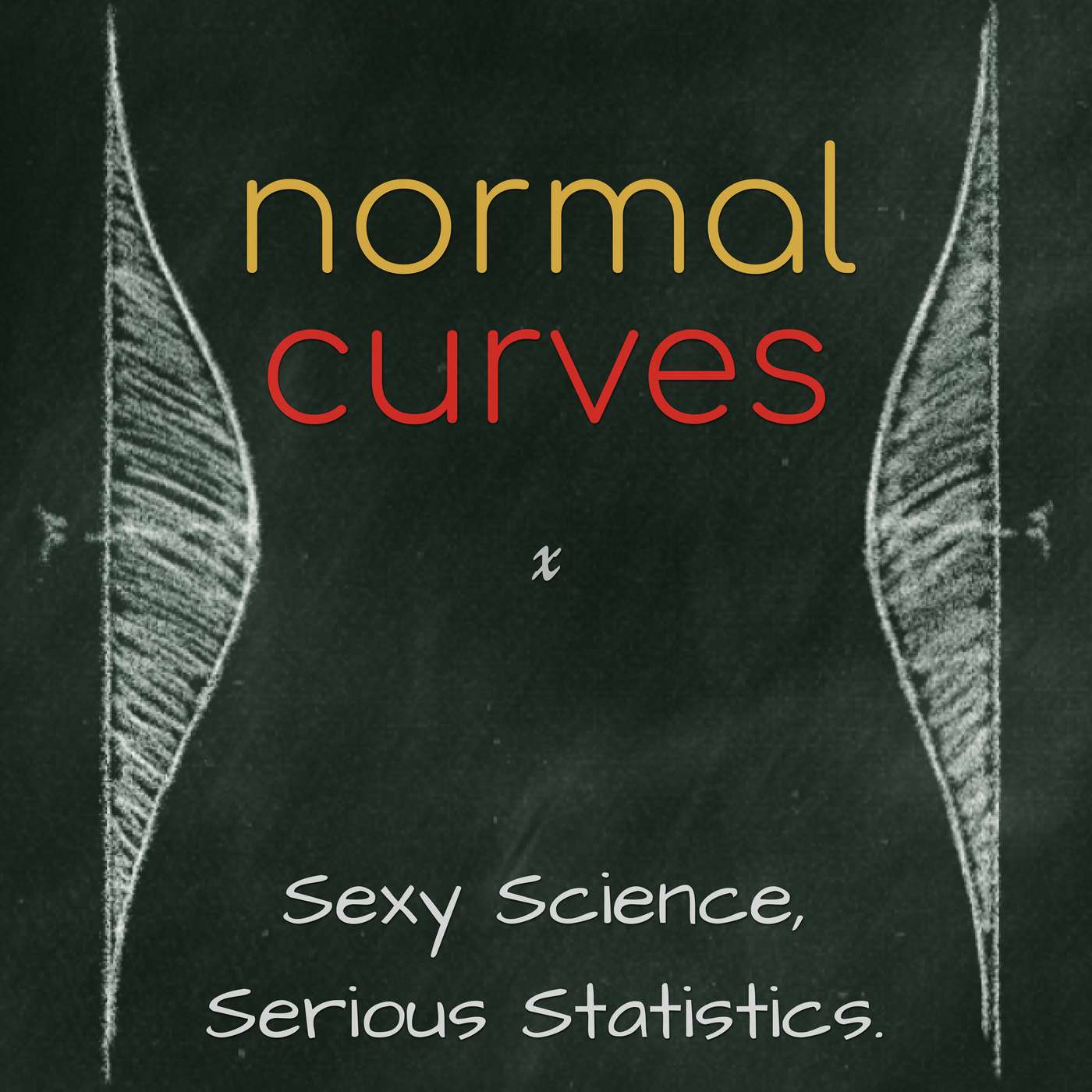
Regina Nuzzo and Kristin Sainani
Normal Curves: Sexy Science, Serious Statistics
Normal Curves is a podcast about sexy science & serious statistics. Ever try to make sense of a scientific study and the numbers behind it? Listen in to a lively conversation between two stats-savvy friends who break it all down with humor and clarity. Professors Regina Nuzzo of Gallaudet University and Kristin Sainani of Stanford University discuss academic papers journal club-style — except with more fun, less jargon, and some irreverent, PG-13 content sprinkled in. Join Kristin and Regina as they dissect the data, challenge the claims, and arm you with tools to assess scientific studies on...
Husk at besøge podcastens hjemmeside og støtte skaberen: www.normalcurves.com
Forfatter
Regina Nuzzo and Kristin Sainani
Kategori
Podcastens hjemmeside
Seneste episode
16. nov. 2026
Hvor kan du lytte?
Podcasts i appen Replaio Radio Kommer snartPodcasts kommer snart til appen. Installer nu, og vær den første til at se en helt ny tilgang til podcasts
 Installer gratis
Android 10 mio.+ downloads · 4,7+ i bedømmelse
iOS snart
Episoder
Holiday Survival Guide Part 2: The survey study edition 01.12.2025 1:02:42
Does the temperature of your coffee six months ago really predict whether you feel gassy today? This week we dissect a new nutrition survey study on hot and cold beverage habits that claims to connect drink temperature with gut symptoms, anxiety, and more—despite relying on year-old memories and a blizzard of statistical tests. It’s the perfect case study for our Holiday Survival Guide Part 2, whe...
Holiday Survival Guide: How to talk about scientific studies around the dinner table 17.11.2025 1:00:29
Does a little alcohol really make you speak a foreign language better? This week we unpack a quirky randomized trial that tested Dutch pronunciation after a modest buzz—and came to the opposite conclusion the researchers expected. We use it as the perfect holiday case study: instead of arguing with Uncle Joe at the dinner table, we’ll show you how to pull apart a scientific headline using a friend...
Shingles Shot and Dementia: Could one vaccine protect your brain? 03.11.2025 1:11:38
What do chickenpox and shingles have to do with your brain? This week, we dig into two 2025 headline-grabbing studies that link the shingles shot to lower dementia rates. We start in Wales, where a birthday cutoff turned into the perfect natural experiment, and end in the U.S. with a multi-million-person megastudy. Featuring bias-variance Goldilockses, Fozzy-the-Bear regression discontinuities, a...
Scary Bridge Study: Can fear make you horny? 20.10.2025 1:03:13
What if a haunted house makes your date look hotter? This week we dive into the infamous Scary Bridge Study — the 1970s classic that launched a thousand pop-psych takes on fear and lust. It’s the one with the swaying bridge, pretty “research assistant,” and phone number scrawled on torn paper. The study became legend, but how sturdy were its stats? We retrace the design, redo the numbers, and see...
Ultramarathons: Can vitamin D protect your bones? 06.10.2025 57:55
Ultramarathoners push their bodies to the limit, but can a giant pre-race dose of vitamin D really keep their bones from breaking down? In this episode, we dig into a trial that tested this claim – and found a statistical endurance event of its own: six highly interchangeable papers sliced from one small study. Expect missing runners, recycled figures, and a peer-review that reads like stand-up...
P-Values: Are we using a flawed statistical tool? 22.09.2025 1:13:26
P-values show up in almost every scientific paper, yet they’re one of the most misunderstood ideas in statistics. In this episode, we break from our usual journal-club format to unpack what a p-value really is, why researchers have fought about it for a century, and how that famous 0.05 cutoff became enshrined in science. Along the way, we share stories from our own papers—from a Nature feature th...
Exercise and Cancer: Does physical activity improve colon cancer survival? 08.09.2025 49:04
Exercise has long been hailed as cancer-fighting magic, but is there hard evidence behind the hype? In this episode, we tackle the CHALLENGE trial, a large phase III study of colon cancer patients that tested whether prescribed exercise could improve cancer-free survival. We translate clinical jargon into plain English, show why ratio statistics make splashy headlines while absolute differences te...
Age Gaps: How much does age matter in dating? 25.08.2025 49:42
Are we all secretly ageist when it comes to dating? We put the stereotype that older men prefer younger women under the microscope using data from thousands of blind dates. What we found surprised us: the “age penalty” was real but microscopic, women wanted younger partners too, and hard age cutoffs weren’t so hard after all. Along the way, we unpack statistical significance versus practical impor...
Your Brain on AI: Is ChatGPT making us mentally lazy? 11.08.2025 1:14:07
ChatGPT is melting our brainpower, killing creativity, and making us soulless — or so the headlines imply. We dig into the study behind the claims, starting with quirky bar charts and mysterious sample sizes, then winding through hairball-like brain diagrams and tens of thousands of statistical tests. Our statistical sleuthing leaves us with questions, not just about the results, but about whether...
The Backfire Effect: Can fact-checking make false beliefs stronger? 28.07.2025 58:26
Can correcting misinformation make it worse? The “backfire effect” claims that debunking myths can actually make false beliefs stronger. We dig into the evidence — from ghost studies to headline-making experiments — to see if this psychological plot twist really holds up. Along the way, we unpack interaction effects, randomization red flags, and what happens when bad citations take on a life of th...
Dating Wishlists: Are we happier when we get what we want in a mate? 14.07.2025 1:05:31
Loyal, funny, hot — you’ve probably got a wish list for your dream partner. But does checking all your boxes actually lead to happily ever after? In this episode, we dive into a massive global study that put the “ideal partner” hypothesis to the test. Do people really know what they want, and does getting it actually make them happier? We explore surprising statistical insights from over 10,000 ro...
Stats Reunion: What have we learned so far? 30.06.2025 56:00
It’s our first stats reunion! In this special review episode, we revisit favorite concepts from past episodes—p-values, multiple testing, regression adjustment—and give them fresh personalities as characters. Meet the seductive false positive, the clingy post hoc ex, and Charlotte, the well-meaning but overfitting idealist. Statistical topics Bar charts vs Box plots Bonferroni correction Confoundi...
HPV Vaccine: How close are we to wiping out cervical cancer? 16.06.2025 1:15:57
Could a preteen vaccine wipe out a global cancer? In this episode, we examine the bold claim that cervical cancer could be eradicated in much of the world by the end of the century—thanks to the highly effective HPV vaccine. We unpack statistical modeling, microsimulations, and how Markov chains make good date-night conversation. We also explore why vaccine uptake has been uneven, how a splash of...
Equipment Size: What is average? 02.06.2025 54:20
Today’s deep dive: the surprisingly serious science of penis size. Using self-report surveys, objective measurements, and a healthy dose of old-school statistics, we ask: How do you get clean data on gentlemen’s goods? Along the way, we explore social desirability bias, survey design tricks, and what happens when science meets insecurity. You’ll never look at a Starbucks cup the same way again. St...
Sugar Sag: Is Your Diet Aging You? 19.05.2025 1:08:27
Wrinkles and sagging skin—just normal aging, or can you blame your sweet tooth? We dive into “sugar sag,” exploring how sugar, processed foods, and even your crispy breakfast toast might be making you look older than if you’d said no to chocolate cake and yes to broccoli. Along the way, we encounter statistical adjustment, training and test data sets, what we call “references to nowhere,” plus som...
Hookworms: Can parasites improve your health? 05.05.2025 1:08:00
What if you could treat your prediabetes with . . . worms? Regina and Kristin dive into a surprising early-phase clinical trial on hookworm therapy—that’s right, intentionally infecting yourself with parasitic worms—to treat metabolic conditions. They dig into the biological rationale (inflammation, abdominal fat, and gut immunology), the clever study design (hello, Tabasco sauce!), and the statis...
Alcohol: Are happy hours good for your heart? 21.04.2025 1:05:31
Does a daily glass of wine really keep the cardiologist away? It’s a claim we’ve all heard: light to moderate drinking is good for your heart. But is it science or just a convenient excuse for happy hour? In this episode, we dive into the history behind this claim, discuss the challenges of observational studies and statistical adjustment, and explore attempts at randomized trials and natural expe...
The Red Dress Effect: Are women in red sexier? 07.04.2025 1:08:45
Wear red and drive men wild with lust – or so says scientific research on color’s role in human mating. But can a simple color swap really boost a woman’s hotness score? In this episode, we delve into the evidence behind the Red Dress Effect, from a controversial first study in college men to what the latest research says about who this trick might work for (and who it might not). Along the way we...
Vitamin D Part 2: Good for more than just your bones? 24.03.2025 1:09:19
Can you really sit on your couch, pop vitamin D pills, and shave seconds off your 5k? Touted as a miracle cure-all, vitamin D is claimed to slash cancer and infection risks while boosting mood, cognition, and athletic performance. But does upping your vitamin D really make you healthier and happier? In this episode, we’ll follow the epidemiologic evidence—from clues in petri dishes through randomi...
Vitamin D Part 1: Is the Deficiency Epidemic Real? 10.03.2025 1:23:09
Is America really facing an epidemic of vitamin D deficiency? While this claim is widely believed, the story behind it is packed with twists, turns, and some pesky statistical cockroaches. In this episode, we’ll dive into a study on Hawaiian surfers, expose how shifting goalposts can create an epidemic, tackle dueling medical guidelines, and flex our statistical sleuthing skills. By the end, you m...
Pheromones: Is sexy sweat the key to genetic diversity? 24.02.2025 57:54
Sweaty t-shirt dating parties, sex pheromone dating sites, choosing your dating partner by sniffing them up — wacko fringe fads or evidence-based mating strategies? And what does your armpit stain have to do with your kids’ immune systems, or hormonal contraceptive pills, or divorce rates? In this episode of Normal Curves, Kristin and Regina reach back into the 1990s and revisit the scientific pa...
Normal Curves: Who are we and what is this podcast about? 17.02.2025 13:31
Welcome to a lively conversation about science that's like a journal club, but with less jargon, more fun, and a touch of PG-13 flair. In this introduction, Professors Regina Nuzzo and Kristin Sainani share how they met in graduate school, what they’ve been doing since then, how they’ll choose edgy topics and journal articles to dissect, and a bit about what makes them tick. Join them for their fr...
Normal Curves Trailer 13.02.2025 2:09
Normal Curves is a podcast about sexy science & serious statistics. Ever try to make sense of a scientific study and the numbers behind it? Listen in to a lively conversation between two stats-savvy friends who break it all down with humor and clarity. Professors Regina Nuzzo of Gallaudet University and Kristin Sainani of Stanford University discuss academic papers journal club-style — except...
Lignende podcasts





Lyt til podcasten Normal Curves: Sexy Science, Serious Statistics i Replaio
Radio og podcasts i én app - gratis og uden tilmelding. Installer i dag, og gå ikke glip af lanceringen
Replaio er ikke podcastudgiver; programmernes navne, coverbilleder og lyd tilhører deres ophavsmænd og distribueres via offentlige RSS-feeds.